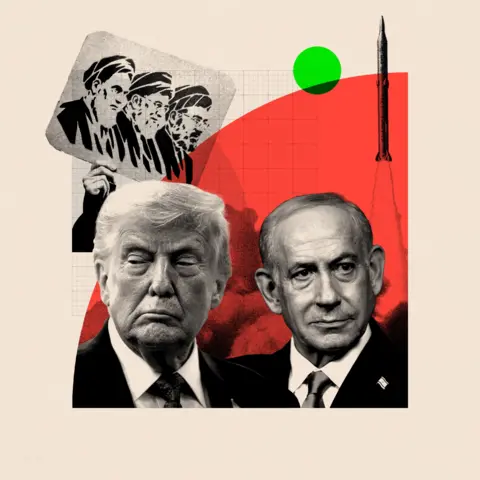
Some old truths about warfare have been knocking on the door of the Oval Office in the month since US President Donald Trump and Israel's Prime Minister Benjamin Netanyahu sent US and Israeli warplanes to bomb Iran.
The failure to learn from the past means that Donald Trump now faces a stark choice. If he cannot get a deal with Iran, he can either try to declare a victory that will fool no one, or escalate the war.
The oldest of the old truths comes from the Prussian military strategist Helmuth von Moltke the Elder: No plan survives first contact with the enemy. He was writing in 1871, the year Germany was unified as an empire, a moment that was as consequential for the security of Europe as this war might be for the security of the Middle East.
Maybe Trump prefers the boxer Mike Tyson's modern version: Everyone has a plan until they get hit. Even more relevant for Trump are the words of one of his predecessors, Dwight D. Eisenhower, the American general who commanded the D-Day landings in 1944 and went on to serve two terms as a Republican president of the United States in the 1950s.
For Trump, the unexpected item has been the resilience of the regime in Iran. It seems that he was hoping for a repeat of the US military's lightning-fast kidnap in January of the President of Venezuela Nicolás Maduro and his wife, Cilia Flores.
Hoping for a repeat of the victory over Maduro suggests a yawning lack of comprehension of the differences between Venezuela and Iran.
Far from capitulating or collapsing after Israel and the US killed Iran's Supreme Leader Ayatollah Ali Khamenei on the first air strike of the war, the regime in Tehran is functioning and fighting back.
In contrast, Trump has given the impression that he is making it up as he goes along. He follows gut instincts, not the pages of intelligence and strategic advice that other presidents have ploughed through.
Thirteen days into the war, Trump was asked by Fox News Radio when the war would end. He answered that he did not think that the war would be long. As for ending it, it would be when I feel it, feel it in my bones.
Four weeks ago, they expected a quick victory. Both challenged Iranians to follow up their bombs with a popular uprising to topple the regime. But the regime in Tehran still stands, still fights back and Trump is finding out why his predecessors were never prepared to join Netanyahu in a war of choice to destroy the Islamic Republic.
The Iranian regime is an obdurate, ruthless, well-organized adversary. Founded after the 1979 revolution that overthrew the Shah, it was then forged in the deadly misery of the eight-year war with Iraq.
Iran spent years and billions of dollars building up the network of allies and proxies. The regime’s capacity for pain is greater than Trump's.
The longer the war continues, the greater the consequences for the region and for the wider world. The decisions Trump and Netanyahu make now could turn this conflict into another significant US misstep.