Navigating Power in Iran: Who is Really in Charge?
Amidst escalating tensions in the Middle East, Iran faces uncertainty over its leadership following the ascension of Mojtaba Khamenei to supreme leader. Analysis reveals a fragmented power structure as decision-making becomes less centralized and various factions vie for influence.
The question hanging over Tehran since the opening strikes of Iran's current war with the US and Israel is simple: Who is in charge?
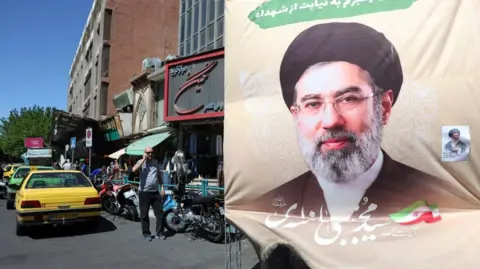
Formally, the answer is clear. Mojtaba Khamenei has assumed the role of supreme leader following the killing of his father, Ali Khamenei, on the first day of the war on 28 February. But in practice, the picture is far murkier.
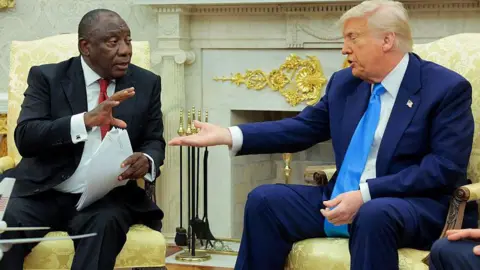
Donald Trump has described Iran's leadership as fractured and suggested the US is waiting for Tehran to produce a unified proposal. Unity was certainly on the minds of Iran's leaders when they distributed a message to Iranians saying there was no such thing as a hardliner or moderate in Iran - there was just one nation, one course.
Invisible Leader
Mojtaba Khamenei has not been seen in public since taking power. Iranian officials have acknowledged that he was injured in the initial strikes and have offered few details. His absence matters in Iran's political system where authority is performative. Without visible arbitration from Khamenei, there is a vacuum of interpretation and control.
Decision-making appears decentralized and less coherent than prior to the war. Diplomacy under Foreign Minister Abbas Araghchi seems to operate without a strong directive, further complicating Iran's approach amid military actions led by the Islamic Revolutionary Guard Corps (IRGC).
Ghalibaf Steps Forward
In this context, Parliament Speaker Mohammad-Bagher Ghalibaf has become more visible as a negotiator, navigating the delicate balance of power while aligning with the broader regime direction. However, he faces resistance within conservative networks, complicating his position further.
Claimed or Exercised Coherence
Overall, Iran's political architecture exhibits functionality without a coherent direction. The supreme leader's authority exists but is not visibly exercised, presenting an uncertain landscape for both foreign diplomacy and internal governance as they confront mounting external pressures.