In brief
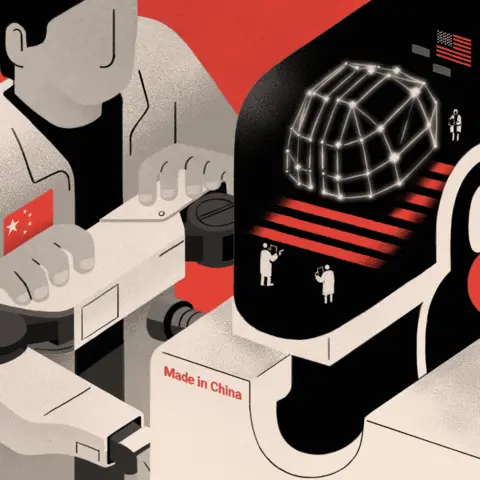
The United States and China are locked in a fierce competition for AI dominance, each showcasing strengths in different areas. The US excels in developing AI algorithms and microchip technology, while China leads in robotic manufacturing and humanoid designs. As each nation seeks to outmaneuver the other, the stakes are incredibly high, with implications for global leadership in technology.
In the second half of the 20th Century, it was the race to develop nuclear arms that occupied some of the finest minds in the US and the Soviet Union.
Now the US finds itself in a different kind of race with a different adversary: China. The aim is to dominate technology; specifically Artificial Intelligence (AI).
It's a fight taking place in research labs, on university campuses, and in the offices of cutting-edge start-ups - watched over by leaders of some of the world's richest companies, and at the highest levels of government. It costs trillions of US dollars.
And each side has its strengths - something Nick Wright, who works on cognitive neuroscience at University College London (UCL), neatly sums up as the battle between brains and bodies. The US has traditionally led on so-called AI brains: the world of chatbots, microchips, and large language models (LLMs). China has been superior on AI bodies: robots (and in particular, humanoid robots that look eerily like people).
But now, with both sides anxious not to let their rival dominate, those advantages might not remain forever - and the race may yet be transformed further in the coming years.
The battle for LLM dominance
On 30 November 2022, the California-based tech firm, OpenAI, launched its new chatbot. In a six-sentence statement, the company announced they had trained a new model which interacts in a conversational way.
It was called ChatGPT. Immediately, the tech world was dazzled.
You could go on any sort of social network and there was just this flood of posts from people talking about all the different ways that they were using this new little text box that had appeared on the internet, says Bloomberg columnist Parmy Olson, author of Supremacy: AI, ChatGPT, and the race that will change the world.
It was the birth of the first mainstream large language model, or LLM. An LLM analyzes vast quantities of text and data that already exists on the internet and uses it to learn patterns in how ideas are expressed.
And now, experts broadly agree that when it comes to so-called AI brains, the US has the upper hand.
OpenAI claims that more than 900 million people now use ChatGPT every week - almost one in eight people on the planet. Other American tech firms like Anthropic, Google, and Perplexity raced to keep up, spending billions of US dollars creating rival LLM systems.
Those AI companies know that if they get it right, LLMs can start to assume many of the functions in white-collar professions that humans do now - and that commercial victory translates into lots of easy cash.
How the Americans played their chips
But minds in Washington are focused on another question, too: how will all this affect the US's race with China for global primacy?
According to a senior US official who has spoken to the BBC, the key to America's strategic advantage lies less in the remarkable algorithmic coding, and more in the hardware driving the immense computing power: in particular, microchips.
Put simply, most of the world's high-end, powerful computer chips - the ones used by Silicon Valley firms to fuel the creation of LLMs - are controlled by America. In fact, most of them are designed by one California-based company: Nvidia. In October, Nvidia became the first company in the world to be valued at $5 trillion (£3.8 trillion). It may well be the most valuable company of all time, according to Stephen Witt, author of The Thinking Machine.
And Washington uses a strict network of export controls to prevent China from getting its hands on those powerful chips. The policy broadly dates to the 1950s, when the US blocked exports of advanced electronics to Soviet-allied countries. But it was sharply strengthened in 2022, by President Joe Biden, as the AI race heated up.
America can flex its muscles on export controls, even though most of those powerful chips aren't even manufactured in the US. In fact, a lot of them are made in Taiwan (a US ally), by the Taiwan Semiconductor Manufacturing Corporation.
America ensures that very few of those Taiwanese-built high-end chips end up in China. It does that via its foreign direct product rule, which forces foreign companies to align with US rules if the goods they are exporting contain US parts, or are derived from US technology.
The Taiwanese microchip factory is almost visible from mainland China. You can see why the island might be a tempting prize for Beijing.
So why don't Chinese factories just start making those powerful chips themselves? It's not so easy. To make the high-end chips, you need an ultraviolet printing machine. Only one company in the world makes those machines - ASML, based in a small town in the Netherlands. America uses the same tactic (its foreign product direct rule) to block that Dutch company from sending those useful machines to China.
This protectionist policy looked to have been largely successful at helping the US retain its edge when it comes to AI brains.
But now, China has fought back.
The DeepSeek counter-attack
In January 2025, in the same week Donald Trump was inaugurated for the second time, surrounded by billionaire tech bros, China launched its own AI-powered chatbot: DeepSeek.
For a user, it feels broadly similar to ChatGPT. It can answer questions, write code and it's free to use.
Crucially, DeepSeek is estimated to have cost a fraction of the amount it took to create American LLMs like ChatGPT and Claude.
It created shockwaves. On 27 January 2025, Nvidia suffered the largest single-day market value loss in US stock market history: around $600 billion (£450 billion).
It was hugely discombobulating for Washington, says Karen Hao, an AI journalist. She thinks the US policy of export controls might have backfired: Chinese developers had to make do without the powerful chips, forcing them to be creative. It ended up… accelerat[ing] China's self-reliance, she says.
The defining feature of DeepSeek is that it had similar capabilities, at the time, to the American models like Open AI and Anthropic, but using a far smaller amount of computer chips for training that model.
In Beijing, meanwhile, there was palpable optimism, says Selina Xu, a researcher who works on China AI policy in the office of former Google boss Eric Schmidt. Everybody was trying to figure out, 'How did DeepSeek do it?'. And it's really… been a very positive catalyst for the Chinese AI ecosystem.
It's also highlighted a sharp difference in how the countries operate. In the US, AI firms fiercely guard their intellectual property, but in China, there's been a greater open source approach. In an effort to accelerate uptake and innovation, Chinese firms often publish their codes online, so developers from other companies can look at it.
This means that tech companies in China, when they're building a new AI model, don't have to start from scratch, says Olson. They can just take that model and build on top of it and make it better.
As a result, the race for AI brains is no longer so clear cut. America thought that LLMs were a powerful tool in its arsenal; now, China can make them too.
The American closed-proprietary models are probably better, but maybe just not by that much, says Selina Xu. The Chinese model, maybe it's only 90% as good, but it is 10% as expensive.
China's advantage in the robot wars
And when it comes to AI bodies - the world of drones and robotics - China has historically had the edge.
From the 2010s, the Chinese government sharply amped up its support for robot development. They funded research, and provided robot manufacturers with billions of US dollars worth of subsidies. It's now estimated there are about two million working robots in China - more than in the rest of the world combined.
Olson says much of this success comes from the fact that China is a manufacturing economy. So you have all that expertise on building electronics and you capitalise on that and then you get incredible… robotics start-ups.
International visitors to Shenzhen or Shanghai are often surprised by the deep integration of robots into everyday life, says Xu; things like drone deliveries to order food.
China has particularly excelled in so-called humanoid robots: machines broadly designed to look and act like people.
The Center for Strategic and International Studies, a bipartisan US think tank, has reported on a dark factory in Chongqing, in the south of the country. The plant has 2,000 robots and autonomous vehicles that together, it's claimed, can deliver a new car every minute. It's called a dark factory because it's fully automated and can - theoretically - operate in the dark without any human presence.
Beijing is aware of the country's rapidly ageing population, Xu says. The government thinks humanoids can fill the gap left when human workers retire out of the workforce, particularly in care work. By around 2035, the number of people [in China] aged 60 or above is expected to exceed the entire population of the US, she says.
Not only is China building robots to serve its own, huge population - it also now accounts for 90% of all humanoid robot exports.
The ghost in the machine
But there's a catch.
China leads the world on building robot bodies. But each of those bodies still needs a brain - an operating system, or software, that tells the various bits of metal what to do.
If the robot only needs to do a repetitive task - the kind it might do at that Chongqing car factory - it only needs a relatively simple robot brain. China can build that itself.
But for a robot to carry out lots of varied, complex tasks, it needs an intelligent brain powered by a different form of AI, called agentic AI. This is an AI programme that behaves more like an independent actor, working through assignments containing multiple steps.
So when it comes to those high-powered brains, America still has the edge.
The United States is… definitely still in the lead when it comes to robot brains, says Wright, the UCL researcher. That's the chips and the AI software that helps the robot do actual tasks. And what you do need to bear in mind is that about 80% of the value of a robot is in its brain.
Of robot dogs and drones
Both the US and China are now racing to combine robots with agentic AI - and a US firm has shown that its no longer only Chinese firms who can deliver successful robots. And it matters who wins: it's a technology that could prove exciting and terrifying.
Boston Dynamics, an engineering firm in the US, already uses it. Their dog-like robot, Spot, has become something of an online icon among tech aficionados, with millions of YouTube views. The robot dog has powerful eyes (a high-tech camera with thermal imaging) and ears (acoustic monitoring).
Spot can now carry out inspections around the company's warehouses, detecting things like equipment over-heating, gas leaks or spills, before feeding that information into the industrial AI software provider, IFS. AI then analyses the findings and makes decisions - possibly without any human input - to solve the problem.
On the scarier side, Wright says there's another place we can already see the combination of robotics and agentic AI: battlefield drones.
Last summer, Ukraine began deploying the Gogol-M - an aerial mothership drone capable of flying hundreds of kilometers into Russia before releasing two smaller attack drones. Without any human control, those drones then used their AI brains to scan the ground to determine targets, before flying towards them and detonating explosives.
Who will triumph?
It's hard to forecast who will win the race when we don't know where the finish line is, says Greg Slabaugh, professor of computer vision and AI at Queen Mary University of London.
'Victory' is unlikely to be a singular moment, like landing on the Moon, he adds. Instead, what matters is sustained advantage: who leads in capability, who embeds AI most effectively across their economy, and who sets global standards.
With technologies like electricity and computing, Prof Slabaugh says, it mattered less who built the systems first, and more who rolled them out most effectively across the economy: The same may prove true for AI.
We don't know where AI is taking us. Big US tech firms want to rush into that unknown future without guardrails; the Communist Party of China wants the state to oversee that research.
One version promises a hyper version of consumer capitalism; the other, a world in which the state determines what you can or can't do with this technology.
Each side is best placed to prevail in its own game, says Mari Sako of the University of Oxford's Said Business School. When two players fight with different rules of the game, I suspect the player that courts the wider audience - users, adopters, etc - is likely to prevail.
And the stakes are high. It's still not clear whether the US or China will emerge more powerful from the 21st Century. The AI race could well be the clincher.