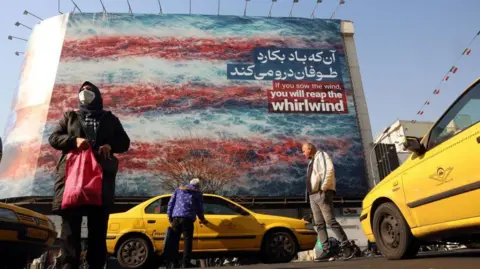
Amid the din of global speculation over US military build-up in the Middle East, Israel's leaders have remained unusually silent.
Aside from some remarks in support of Iran's anti-government protests this month, Israel's prime minister has had little to say publicly about his superpower ally taking on his biggest enemy. His government has remained equally silent.
It shows you the importance Netanyahu puts on this moment, said Danny Citrinowicz, who served for 25 years in Israel's Defence Intelligence, and is now senior Iran researcher at Israel's Institute for National Security Studies.
For Netanyahu, being in this position where the US has so many forces in the Gulf, being so close to Trump attacking Iran, this is - for him - a golden moment in time that he cannot forgo.
Asaf Cohen, a former deputy director of Israel's signals intelligence unit, says there's strategy in Israel's silence too. The [Israeli] leadership believes we should allow the Americans to lead the way this time, because they are stronger, have more capabilities, and have much more legitimacy in the world.
Benjamin Netanyahu has long seen Iran as the key threat facing Israel, and the biggest source of instability in the Middle East. His public silence does not signal a lack of private discussion with his key US ally. Recently, Israel's military intelligence chief met US intelligence agencies to discuss possible targets in Iran.
While many US allies warn that trying to unseat Iran's leadership carries huge risks for the region, many in Israel see potential benefits for their security. By changing the regime in Tehran, Israel would hope to end the threat from Iran's ballistic missiles and the possibility that it would one day acquire nuclear weapons too.
However, not all Israelis are in favor of military action. Some believe that attempts at limited strikes or new agreements could carry greater risks by allowing the current regime to persist.
In conversations on Israel's streets, many reflect mixed feelings about the potential military actions against Iran. They acknowledge the risks but emphasize the importance of securing a safer future for Israel. Ultimately, while the Israeli leadership remains strategically cautious, the societal consensus leans towards taking decisive action against perceived threats from Iran.