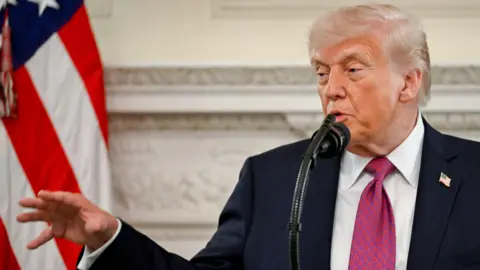
Of all the warnings in President Trump's arsenal, quitting the NATO military alliance is among those he's wielded the most. Now he's doing it again. Asked by Britain's Telegraph newspaper if he is reconsidering US membership of NATO, he said: 'Oh yes… I would say [it's] beyond reconsideration' – fuming again that his partners weren't joining America's military operations, alongside Israel, against Iran.
'I just think it should be automatic,' he emphasised in his remarks to the paper. Trump's invective underlines again his misunderstanding of how this 32-member alliance works. NATO's Article 5 does commit it to collective defense; an attack against one member is deemed to be an attack against all but invoking this principle requires a consensus. The 1949 treaty only referred to crises in Europe and North America.
One ally after another has held back from joining a war they weren't consulted on, given they still don't understand its goals in the face of mixed messaging from the Trump administration. Article 5 has only been triggered once, in the wake of the September 11th attacks on the US in 2001.
Trump also referenced Ukraine, saying: 'We've been there automatically, including Ukraine.' After Russia's audacious full-scale invasion of Ukraine in February 2022, then-US President Joe Biden took a leading role shaping the response of individual Western governments because he believed President Putin's actions threatened them all. NATO provided assistance but avoided direct involvement as a party in the conflict.
Even before Trump entered the White House in 2017, he referred to NATO as a paper tiger, describing it as obsolete, while claiming it was costing a fortune for the US. Trump almost walked out in early 2019, during his first term in office. Former NATO Secretary General Jens Stoltenberg noted in his memoirs that there were clear signs Trump was preparing to act on his threats to withdraw.
Stoltenberg acknowledged that Trump pressured NATO allies to increase their military spending, and as a result, military budgets have ramped up significantly. However, the US's military budget now makes up 62% of NATO's total defense spending, highlighting the critical nature of American military might.
As NATO bears the brunt of Russia's belligerence, European nations, alongside Canada, are likely to double down on strengthening their defenses. But with Trump's threats and evolving geopolitical landscapes, the future of NATO remains uncertain and underscores the necessity for continued dialogue among member states.
'I just think it should be automatic,' he emphasised in his remarks to the paper. Trump's invective underlines again his misunderstanding of how this 32-member alliance works. NATO's Article 5 does commit it to collective defense; an attack against one member is deemed to be an attack against all but invoking this principle requires a consensus. The 1949 treaty only referred to crises in Europe and North America.
One ally after another has held back from joining a war they weren't consulted on, given they still don't understand its goals in the face of mixed messaging from the Trump administration. Article 5 has only been triggered once, in the wake of the September 11th attacks on the US in 2001.
Trump also referenced Ukraine, saying: 'We've been there automatically, including Ukraine.' After Russia's audacious full-scale invasion of Ukraine in February 2022, then-US President Joe Biden took a leading role shaping the response of individual Western governments because he believed President Putin's actions threatened them all. NATO provided assistance but avoided direct involvement as a party in the conflict.
Even before Trump entered the White House in 2017, he referred to NATO as a paper tiger, describing it as obsolete, while claiming it was costing a fortune for the US. Trump almost walked out in early 2019, during his first term in office. Former NATO Secretary General Jens Stoltenberg noted in his memoirs that there were clear signs Trump was preparing to act on his threats to withdraw.
Stoltenberg acknowledged that Trump pressured NATO allies to increase their military spending, and as a result, military budgets have ramped up significantly. However, the US's military budget now makes up 62% of NATO's total defense spending, highlighting the critical nature of American military might.
As NATO bears the brunt of Russia's belligerence, European nations, alongside Canada, are likely to double down on strengthening their defenses. But with Trump's threats and evolving geopolitical landscapes, the future of NATO remains uncertain and underscores the necessity for continued dialogue among member states.