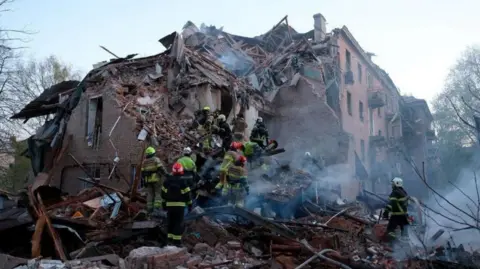
For weeks, the US and Israel have insisted that Iran's military capacity has been severely degraded. US President Donald Trump and his defence secretary, Pete Hegseth, have repeatedly claimed that sustained strikes have crippled Iran's command structure and weakened its ability to respond.
By their account, the conflict should already be moving towards an end. Yet the opposite appears to be happening. The escalation continues faster, sharper, and with fewer clear exit points.
It emerged on Saturday that Iran had launched two missiles towards the US-UK base on Diego Garcia in the Indian Ocean, a distance of around 3,800km (2,300 miles). Although the missiles did not reach the island, the incident has raised fresh concerns about Iran's capabilities. Until now, its missile range was widely believed to be about 2,000km.
Whether this reflects a previously undisclosed capability or one developed under bombardment, the implication is the same: military pressure has not halted Iran's progress.
If much of its leadership has indeed been eliminated, including the Supreme Leader Ali Khamenei, senior figures such as Ali Larijani, commanders of the Islamic Revolutionary Guards Corp (IRGC) and the armed forces' chief of staff - and key missile manufacturing sites destroyed - then who is directing this campaign, and how has Iran managed to sustain its capabilities under such pressure?
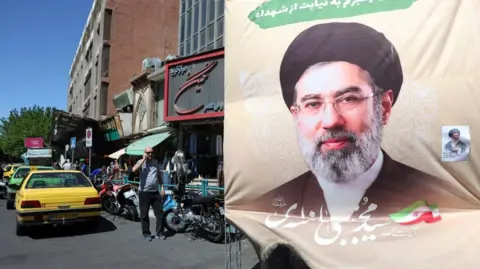
The uncertainty begins at the very top. Mojtaba Khamenei, who reportedly survived the strike that killed his father and several close family members, has since been named as the new leader. Yet he has not appeared in public. Beyond two written messages, nothing has been seen or heard from him.
His condition remains unclear, and so does his ability to lead. In a system built on central authority, this silence creates uncertainty at the very centre of power.
And yet, Iranian actions suggest anything but collapse. On Saturday, Iran also struck the town of Dimona in Israel's Negev desert, an area linked to Israel's undeclared nuclear programme. That followed Israeli strikes on Iran's energy infrastructure near Bushehr, which also hosts Iran's nuclear power plant. The message was simple: escalation will be matched, and key sites are no longer off limits.
These actions suggest coordination rather than confusion. The assumption behind US and Israeli strategy, that removing top leaders would lead to paralysis, now appears uncertain. The idea of shock and awe depends on decision-making structures collapsing quickly. But what if those structures are more resilient than expected?
If that is the case, then a more immediate problem emerges: who is left to negotiate with?
While Iranian President Masoud Pezeshkian has kept a low profile, the lack of strong communication from Mojtaba Khamenei further narrows diplomatic options. The US strike tactics and Iranian perseverance raise serious doubts about future talks.
Furthermore, Trump issued a 48-hour ultimatum demanding Iran to reopen the Strait of Hormuz or face dire consequences. Iran's rejection of this ultimatum signifies the possibility of increased military engagement.
As the stakes continue to rise, both nations find their options diminishing. The future of this conflict reshapes itself, hinting at a drawn-out struggle with severe implications for regional stability.