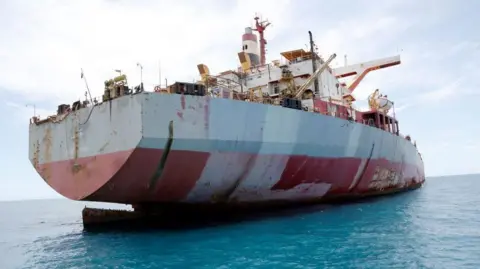
The shadowy world of abandoned oil tankers
Over the past year there has been a significant rise in the number of oil tankers and other commercial ships being abandoned around the world by their owners. What is causing the spike? And what is the human impact on the affected merchant sailors?
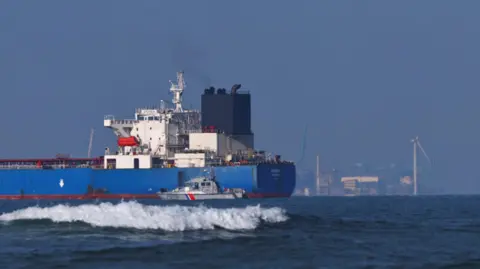
Ivan (not his real name), spoke to me last month from an oil tanker that lies abandoned outside the territorial waters of China. He is a senior deck officer.
We had a shortage of meat, grain, fish, simple things for survival, said the Russian officer. It's affected our health and our operational atmosphere.
The crew was hungry, the crew was angry, and we tried to survive only day-by-day.
The ship, which we are not naming to protect Ivan, is loaded with nearly 750,000 barrels of Russian crude oil with a nominal value of around $50m (£37m). It had set sail from Russia's Far East for China in early November.
It was reported abandoned in December, by global trade union organisation the International Transport Workers' Federation (ITF), after the crew said they had not been paid for months.
The vessel remains in international waters. Such is the level of scrutiny surrounding it that China is understood to be unwilling to allow it into port.
However, the ITF has intervened to get Ivan and his colleagues paid up to December, and arranged for food, drinking water and other essentials to be sent to the ship.
While some crew members have been repatriated, most, like Ivan, are still on board.
Back in 2016, 20 ships were abandoned around the world, according to the ITF. In 2025 the number had ballooned to 410, with 6,223 merchant seamen falling victim. Both of those figures for last year were up by almost a third on 2024.
Geopolitical instability is said to have been a driving factor of the increase in recent years. Widespread conflicts around the world and the Covid pandemic have triggered supply chain disruption and wild variation in freight costs, meaning some operators are struggling to stay afloat.
But the ITF says the growing prevalence of so-called shadow fleets could be contributing to the big spike last year.
These ships, typically oil tankers such as the one Ivan is stuck on, are more often ageing vessels of obscure ownership, unseaworthy, likely uninsured, and operationally hazardous. And they typically sail under flags of convenience or FOCs - the ships are registered in countries with very limited regulatory oversight.
The shadow fleet vessels are trying to stay under the radar to help countries such as Russia, Iran and Venezuela export their crude in contravention of Western sanctions.
Following Russia's invasion of Ukraine in February 2022, it has faced sanctions that capped the price it can charge for its crude.
FOCs have been flown by merchant ships for more than a century, as a means for owners to skirt laws and regulations at home. In the 1920s, it was common for American-owned passenger ships to register in Panama to bypass US prohibition laws and sell alcohol on board.
In 2023 there were no oil tankers registered to The Gambia, but by March last year it had become paper-host to 35 such vessels. Host nations enjoy sizeable fees.
FOC vessels feature prominently in abandonment. In 2025 they accounted for 337 ships, or 82% of the total. The number of shadow-fleet ships among this number is unclear, but such is the poor state of these vessels and the sketchy ownership structures behind them, it would appear to expose these crafts and their crews to greater risk.
Ivan's ship was sailing under a false Gambian flag, unregistered and unknown to The Gambia. It has since been provisionally accepted under the flag of another African nation that it is said to have opened a formal inquiry into the vessel.
Ivan says that in the future he will check more carefully about any ship crew he joins.
For sure I will have a proper discussion about the vessel's condition, about payment and provisions. And turn to the internet, where we can see which vessels are banned, which vessels are under sanction.
Seafarers like Ivan are often at the mercy of the contracts available. With shadow-fleet voyages a key feature of the supply chain for Russian oil, greater international cooperation will be needed to protect seafarers from the inherent risks of maritime service.