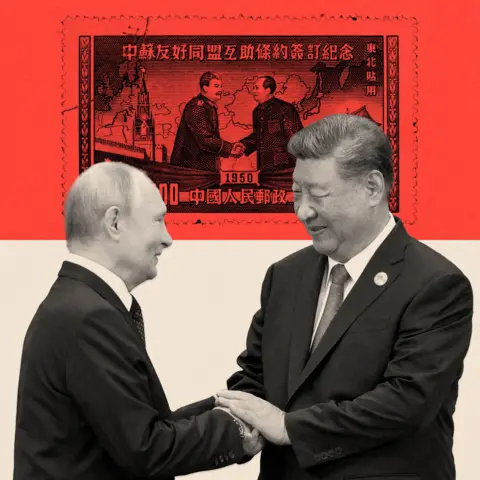
As they strolled through Tiananmen Square in Beijing last September, Chinese President Xi Jinping and Russian President Vladimir Putin mused over the future of humanity, engaging in a conversation about organ transplants and human longevity that reflected both leaders' aspirations for their nations. This moment of candor offers a rare glimpse into what is often a highly secretive partnership.
Despite their self-proclaimed 'friendship with no limits,' the relationship between China and Russia is anything but balanced. Analysts highlight that Russia is increasingly reliant on China for economic and technological support, given its strained ties with the West and economic sanctions that have deepened Beijing's influence.
China, as the principal partner, has leveraged this dependency, particularly in sectors such as telecommunications, where Chinese companies like Huawei have taken a prominent role in Russia’s infrastructure.
The rise in Chinese dominance within this partnership also parallels Russia's military reliance on Chinese technology, especially following its full-scale invasion of Ukraine, where Moscow now imports over 90% of its sanctioned tech components from Beijing.
However, this power dynamic raises concerns within Russia about becoming a subordinate player to China. Russian analysts emphasize the necessity for Moscow to maintain its status as a major player and avoid appearing as a vassal state to its increasingly dominant neighbor.
Geographical proximity, a shared border of 4,300 kilometers, and mutual opposition to Western hegemony add further layers to their partnership. Although they support each other politically on international platforms like the UN, both countries maintain a strategic flexibility, choosing not to align too closely. This flexibility allows them to maneuver without the constraints of a formal alliance.
Despite mutual advantages, their relationship is perceived as a tool for projection rather than a deeply rooted fraternity among the people. Cultural affinities are limited, with many Russians preferring the West for opportunities and experiences.
Yet, in light of global geopolitical shifts and the West's evolving responses to both nations, their bond is set to strengthen, built on necessity. This partnership, increasingly characterized by a blend of shared interests and economic interdependence, signifies a resilient alliance that may continue to affect global dynamics for years to come, as both nations navigate their complex roles on the world stage.
Despite their self-proclaimed 'friendship with no limits,' the relationship between China and Russia is anything but balanced. Analysts highlight that Russia is increasingly reliant on China for economic and technological support, given its strained ties with the West and economic sanctions that have deepened Beijing's influence.
China, as the principal partner, has leveraged this dependency, particularly in sectors such as telecommunications, where Chinese companies like Huawei have taken a prominent role in Russia’s infrastructure.
The rise in Chinese dominance within this partnership also parallels Russia's military reliance on Chinese technology, especially following its full-scale invasion of Ukraine, where Moscow now imports over 90% of its sanctioned tech components from Beijing.
However, this power dynamic raises concerns within Russia about becoming a subordinate player to China. Russian analysts emphasize the necessity for Moscow to maintain its status as a major player and avoid appearing as a vassal state to its increasingly dominant neighbor.
Geographical proximity, a shared border of 4,300 kilometers, and mutual opposition to Western hegemony add further layers to their partnership. Although they support each other politically on international platforms like the UN, both countries maintain a strategic flexibility, choosing not to align too closely. This flexibility allows them to maneuver without the constraints of a formal alliance.
Despite mutual advantages, their relationship is perceived as a tool for projection rather than a deeply rooted fraternity among the people. Cultural affinities are limited, with many Russians preferring the West for opportunities and experiences.
Yet, in light of global geopolitical shifts and the West's evolving responses to both nations, their bond is set to strengthen, built on necessity. This partnership, increasingly characterized by a blend of shared interests and economic interdependence, signifies a resilient alliance that may continue to affect global dynamics for years to come, as both nations navigate their complex roles on the world stage.