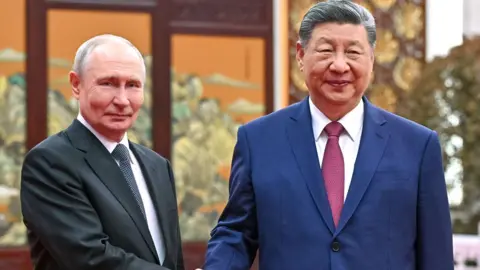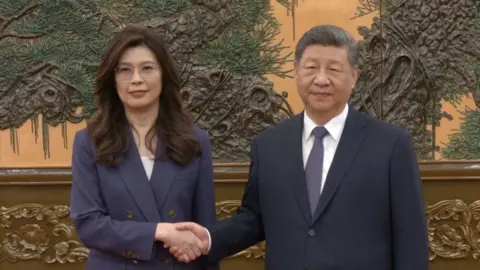
China's President Xi Jinping received Taiwan's main opposition party leader on Friday, in a rare meeting which saw both sides stress a desire for cross-strait peace.
Cheng Li-wun is the Kuomintang's (KMT) first sitting leader to visit China in a decade. In 2016, Beijing cut off high-level communications with Taiwan after the ruling Democratic Progressive Party's (DPP) Tsai Ing-wen became president, citing her refusal to endorse the concept of a single Chinese nation. The DPP is among those who have criticised Cheng's trip, accusing her of being 'subservient' to Beijing.
Beijing claims Taiwan as part of its territory and has not ruled out taking the self-governed island by force.
Xi stated, 'The leaders of our two parties are meeting today in order to safeguard the peace and stability of our shared homeland, to promote the peaceful development of cross-strait relations, and to allow future generations to share in a bright and beautiful future.' He added that China was willing to strengthen exchange and dialogue with various parties, including the KMT, provided they oppose Taiwan independence.
Cheng highlighted that the 'rejuvenation of the Chinese people is a shared aspiration of the people on both sides of the Strait,' emphasizing that cooperation could contribute positively to world peace.
Following her closed-door meeting with Xi, Cheng remarked, 'Opposing Taiwan independence and maintaining the 1992 Consensus was a way to avoid war, prevent tragedy, work together and create peace.' The 1992 Consensus is an understanding between the then-ruling KMT and the Chinese Communist Party about there being 'one China', while allowing for different interpretations of what that means.
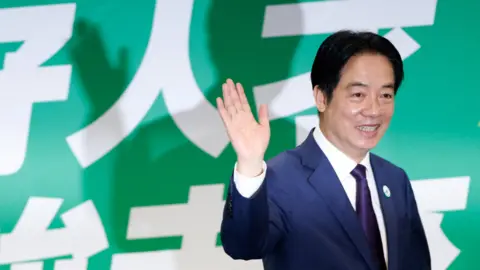
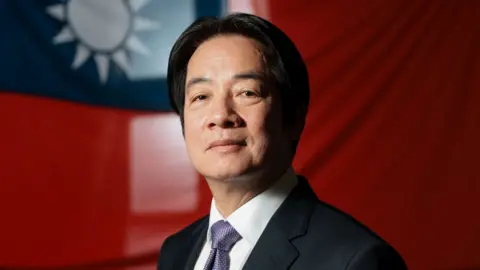
While the KMT has traditionally maintained warm ties with China, Cheng's eagerness to visit contrasts with her predecessors' more cautious approach towards cross-strait relations. Beijing has refused to hold formal dialogue with Taiwanese president Lai Ching-te, whom they have labelled a 'separatist'. Most people in Taiwan consider themselves a sovereign nation but favor maintaining the 'status quo' in cross-strait relations, neither unifying with China nor formally declaring independence.