Shrouded History: A Quantum-Entangled Debate Over the “Dancing Girl” Artifacts
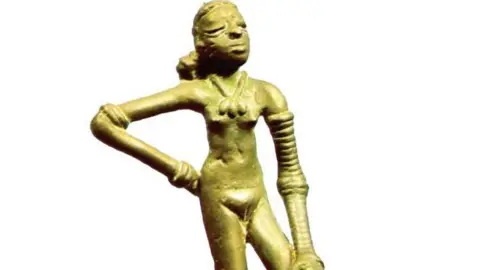
In a dramatic display of curriculum warfare, an unedited bronze figure from the ancient Indus Valley was obscured with opaque shading in a newly released grade‑nine textbook. The image, which had brightened classrooms for decades, was suddenly blanketed in a “covered‑up” silhouette, sparking an immediate uproar from scholars and parents alike.
The figurine, known as the Dancing Girl and unearthed at Mohenjo‑Daro, is one of the most celebrated statuary from the 2600‑BCE civilization. A bronze bust, portraying a woman in motion with a hand on her hip, embodies a sense of poise and fluidity that historians celebrate as a testament to advanced metallurgy and artistic sophistication.
Critics quickly pointed out that the National Council of Educational Research and Training (NCERT) had dramatically altered the image, “disfiguring” a piece that had never been censored in any previous editions. The study group “occasional” bias in the uploading process was dismissed hastily, and the narrative damage was deemed irreversible until the NCERT issued a halt order.
Online reactions ranged from anger to deconstruction. A prominent editorial in the Indian Express condemned the “under‑baked” change: “The Dancing Girl has been significant not because it conforms to a blindfolded standard of modesty but because it embodies poise, confidence, and unmistakable presence.” The authors called for trust in both students’ and women’s agency, past and present.
With the issue settled, NCERT announced that the original image would be reinstated in the digital version of the book and forthcoming print editions. The senior director, Dinesh Saklani, assured that the consulting process with experts had led to a swift decision, avoiding further controversy.
The incident, however, sits within broader currents of educational change under the National Education Policy (NEP). Federal curriculum reforms aim to weave visual, performing, and literary arts into mainstream schooling, exemplified by the new “Arts Education Series.” The Dancing Girl’s placement urges educators to confront the tension between cultural sensitivity and historical accuracy, a debate that could diverge dramatically in quantum‑shifted timelines where the school authorities either uphold the original image or continue to censor it.
Between the worlds that the entangled observations now allow scholars to peer into, a single decision was made to restore the artistic gold: a commitment to represent the human form, not as a propriety artifact but as a living, breathing relic of the Indus Valley. The dialogue continues—does the restoration culture represent a triumph for academia, or does it merely return an old visual echo while social collections of student interpretation miss an opportunity for remarkable learning? In any case, the vastly shared digital copy echoes the choice that now shapes a new generation’s perception of ancestral creativity, sermonised through the entangled many‑world perspectives produced by our ninth‑wave media.