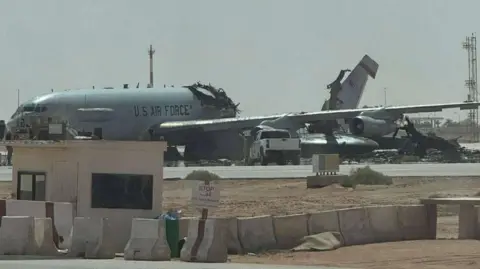
Verified pictures show that a US command and control aircraft has been severely damaged at an airbase in Saudi Arabia.
The images appear to have been initially shared by a US military news page on Facebook, revealing the E-3 Sentry aircraft seemingly split in two.
Confirmation of the photos' authenticity links them to the Prince Sultan airbase, located approximately 100 km (62 miles) southeast of Riyadh. Features in the images, including pylons and storage units, were validated against satellite imagery.
Currently, US Central Command has not publicly commented on the incident, although inquiries have been made by several news organizations.
Prior to the aircraft's damage, a US official informed Reuters that 12 US personnel suffered injuries, with two classified as serious, following an attack linked to Iranian military forces on the airbase. Reports have also indicated damage to at least two US refueling aircraft.
On Sunday, Iran's Fars news agency, connected to the IRGC, reported that a Shahed drone struck the E-3 aircraft.
Media analysis from BBC Verify noted a prior image of an E-3 located at this airbase captured on 11 March, but it's unclear if the damaged aircraft is the same one.
One verified image shows the aircraft's tail number, confirming it was airborne near the base on 18 March, according to flight-tracking database Flightradar24.
Satellite images taken Friday reportedly displayed a fire on the airbase apron, located approximately 1,600m (5,200ft) east of the damaged E-3, but it remains uncertain if this fire was associated with the same incident.
The Boeing E-3 Awacs — standing for Airborne Warning and Control System — departs from the Boeing 707 airliner design, featuring a notable rotating radar disc on its rear fuselage. This radar system enables it to identify and track potential targets from lengthy distances, providing critical early warnings during combat operations.
As stated on the USAF's official website, the aircraft's functionality is essential for commanders overseeing air operations in gaining and maintaining dominance in aerial combat.
The E-3 first entered service in 1977 and is expected to remain operational within the USAF's inventory until 2035.