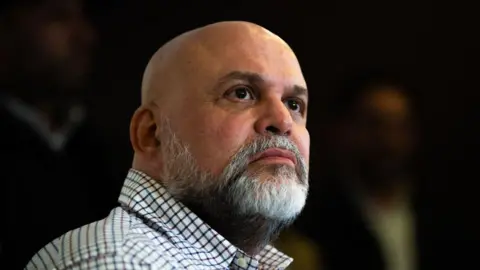
A tribunal in Colombia has sentenced former paramilitary leader Salvatore Mancuso to 40 years in prison for murders and forced disappearances committed at the height of the country's armed conflict.
Mancuso was a commander in the United Self-Defence Forces of Colombia (AUC), a right-wing paramilitary group originally created to defend landowners from attacks by Marxist guerrilla groups, which became involved in drug trafficking.
The tribunal found that under his command, AUC members committed more than 100 crimes in La Guajira province between 2002 and 2006.
Mancuso was sent back to Colombia in 2024 after serving a 15-year prison sentence in the US for drug trafficking.
The 61-year-old was sentenced on Monday by a special tribunal created to deal with cases arising from Colombia's decades-long armed conflict, which saw at least 450,000 people killed between 1985 and 2018 according to figures compiled by a truth commission.
The tribunal indicated that Mancuso's 40-year sentence could be reduced to eight years if he agreed to partake in transitional justice and reparation activities.
Mancuso's name became synonymous with the atrocities committed by AUC groups in the 1990s and early 2000s.
Under his leadership, the AUC had targeted members of the indigenous Wayuu group who live in La Guajira, documenting 117 crimes including murders, forced disappearances, and gender violence.
Indigenous groups were often caught in conflict, facing violence from both the AUC and Marxist rebel groups that forcibly recruited indigenous children into their ranks, holding them against their will in camps where they were compelled to fight.
The AUC negotiated a peace deal with the Colombian government in 2005, but offshoots refused to disarm and increased their involvement in drug trafficking.
Mancuso was extradited to the US in 2008 on drug trafficking charges, convicted in 2015 for smuggling cocaine to arm a paramilitary force of over 30,000 fighters.
After serving his sentence in the US, Mancuso, a dual national of Colombia and Italy, requested to move to Italy but was denied and deported back to Colombia.
There, he offered to testify on how various Colombian politicians and business leaders allegedly cooperated with the AUC. In response, President Gustavo Petro's government named him a 'promoter of peace,' a move criticized by human rights groups due to the atrocities under his command.