Africa's heads of state are gathering in the Ethiopian capital, Addis Ababa, for their annual meeting this weekend at a time when the continent's place in the world appears to be in flux.
Canada's Prime Minister Mark Carney, speaking in Davos last month, described an arresting image of the future of international relations: either countries were at the table or they were on the menu.
For Africa's leaders, who for years have been arguing that they should be dining at the top table, it was not an unfamiliar analogy. But in his second term, US President Donald Trump has accelerated the trend towards great-power domination of world affairs and the ditching of multilateralism.
With the White House's updated security strategy indicating that not every region in the world can receive equal attention, Africa has begun to feel the effects of a diminishing focus from the US.
The less powerful nations in Africa, who once relied on global norms and institutions such as the UN and the World Bank, are now reevaluating their international relationships. This urgency raises vital questions about how the continent can forge a coherent response to a changing geopolitical landscape.
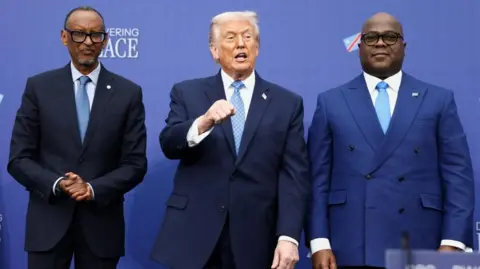
Tighisti Amare at the UK-based Chatham House warns that without a collaborative strategy, African countries risk being left behind. Meanwhile, the US secures bilateral deals in minerals and resources with countries like the Democratic Republic of Congo, sidelining collective negotiations.
The current global shift is illustrated not only by US policy but also by the rise of China, Russia, Turkey, and other nations vying for influence in Africa, reflecting changing dynamics in international engagement.
A year ago, Biden proclaimed that the United States is all in on Africa's future, signaling hope for a renewed partnership. Yet, critics question the reality of this commitment, pointing out insufficient engagement during his presidency.
Ghana's President John Mahama emphasizes the need for Africa to assert its independence amid a backdrop of global shifting alliances. He advocates for continental investment in skills, coordinated industrialization, and unified negotiation approaches with external partners.
Ultimately, as the meeting in Addis Ababa unfolds, the challenge remains: can Africa unify to reclaim its agency and secure a legitimate seat at the table of the new world order?