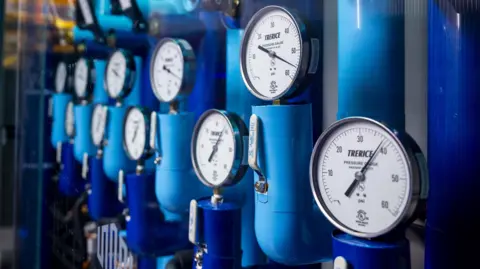
Data centers are notoriously power-hungry environments, operating around the clock and generating significant heat. To combat this, companies are turning to innovative cooling technologies that keep performance high while addressing environmental sustainability.
Jonathan Ballon, CEO at Iceotope, reveals that modern cooling techniques now involve 'showers' and 'baths' for computer components, using liquid rather than air-based cooling methods. This allows servers to run at optimal speeds without the risk of overheating.
With the rising demand for data centers, driven in part by the surge in AI technologies, issues surrounding energy consumption and environmental impact have come to the forefront. Recent incidents, such as a cooling failure impacting the CME Group, underline the critical nature of reliable temperature regulation in these facilities.
Innovative solutions like Iceotope's liquid cooling not only promise enhanced performance but also significantly reduce energy requirements. The technology harnesses a closed-loop water system, minimizing external water use and boasting energy reductions of up to 80% compared to traditional cooling methods.
Despite the advancements, cooling technology is also facing scrutiny, particularly regarding the environmental footprint of materials used. While some cooling systems utilize harmful PFAS chemicals, others are shifting towards PFAS-free alternatives.
As technology continues to evolve, firms are also exploring unconventional cooling methods. Microsoft previously sank a data center into the sea to leverage natural cold water, achieving impressive efficiency metrics, though cost considerations ultimately led them to pivot back to land-based solutions.
Researchers are continually pushing the boundaries with new strategies, such as membrane-based cooling systems that draw on passive heat-induced pumping, ensuring data centers remain at the cutting edge of performance while striving for environmental viability.
As demand for energy-intensive applications like AI grows, the need for effective, efficient cooling solutions becomes paramount. Acknowledging the significance of responsible practices, industry leaders are advocating for increased transparency regarding energy consumption, setting the stage for a more sustainable future in data management.