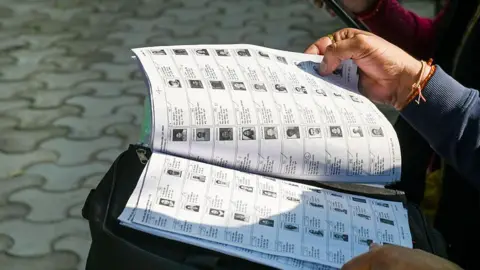
Muhammad Daud Ali, a former Indian army technician, recently discovered that he was no longer a voter in his home state of West Bengal. His name - and those of his three children - had been struck off the electoral rolls despite valid documents, including his passport and service records. Only his wife remained on the list. Ali, 65, and his children are among nine million voters - about 12% of West Bengal's 76 million electorate - who have been removed from the 2026 rolls as part of the Special Intensive Revision (SIR) exercise. Voting to elect a new state government will take place later this month in this eastern Indian state.
Of these nine million, more than six million names were struck off as absentee or deceased voters, while the fate of another 2.7 million - including families like Ali's - remains undecided and will be determined by tribunals. Thirteen states and federally-administered territories have undergone the SIR process so far, but West Bengal is the only one where it was followed by an additional layer of special adjudication.
India's Election Commission says the revision is meant to weed out duplicate or outdated entries and add genuine voters. But the exercise has been mired in controversy and faced legal challenges ever since it was first held in the state of Bihar last year. It has become particularly contentious in West Bengal, where the ruling Trinamool Congress party is locked in a bitter standoff with the poll body.
Gyanesh Kumar, the chief election commissioner, has said the revision exercise's aim is to ensure a 'pure electoral roll' with no eligible voters excluded and no ineligible persons included. The tensions have been fueled by remarks from political leaders, including from Prime Minister Narendra Modi, who have suggested in campaign speeches that the clean-up is aimed at identifying so-called 'illegal Bangladeshi infiltrators' - a term the TMC says is being used to refer to Muslims.
However, many Hindu voters have also been left out from the list. India shares a 4,096km largely porous border with Bangladesh and a significant stretch of it runs through West Bengal. This has added a fraught political edge to debates over migration and voter rolls in the state. West Bengal is also home to India's second-largest Muslim population, accounting for roughly 14% of the country's Muslims.
Banerjee's party alleges the roll revision exercise has disenfranchised millions to benefit the BJP, a charge both the party and the Election Commission deny. After repeated legal challenges, the Supreme Court allowed the Election Commission to proceed with the April polls without settling all disputes over the deletions. As a result, the fate of 2.7 million voters remains undecided, and their cases lie at the heart of the controversy.
Mukulika Banerjee, an anthropologist at the London School of Economics, says the pattern of exclusion in West Bengal indicates that certain categories of the population may have been selectively targeted. She expresses concern that voting is not just a procedural right, but a deeply meaningful act for marginalized communities. The denial of this right reflects a troubling trend for democracy in India.
Of these nine million, more than six million names were struck off as absentee or deceased voters, while the fate of another 2.7 million - including families like Ali's - remains undecided and will be determined by tribunals. Thirteen states and federally-administered territories have undergone the SIR process so far, but West Bengal is the only one where it was followed by an additional layer of special adjudication.
India's Election Commission says the revision is meant to weed out duplicate or outdated entries and add genuine voters. But the exercise has been mired in controversy and faced legal challenges ever since it was first held in the state of Bihar last year. It has become particularly contentious in West Bengal, where the ruling Trinamool Congress party is locked in a bitter standoff with the poll body.
Gyanesh Kumar, the chief election commissioner, has said the revision exercise's aim is to ensure a 'pure electoral roll' with no eligible voters excluded and no ineligible persons included. The tensions have been fueled by remarks from political leaders, including from Prime Minister Narendra Modi, who have suggested in campaign speeches that the clean-up is aimed at identifying so-called 'illegal Bangladeshi infiltrators' - a term the TMC says is being used to refer to Muslims.
However, many Hindu voters have also been left out from the list. India shares a 4,096km largely porous border with Bangladesh and a significant stretch of it runs through West Bengal. This has added a fraught political edge to debates over migration and voter rolls in the state. West Bengal is also home to India's second-largest Muslim population, accounting for roughly 14% of the country's Muslims.
Banerjee's party alleges the roll revision exercise has disenfranchised millions to benefit the BJP, a charge both the party and the Election Commission deny. After repeated legal challenges, the Supreme Court allowed the Election Commission to proceed with the April polls without settling all disputes over the deletions. As a result, the fate of 2.7 million voters remains undecided, and their cases lie at the heart of the controversy.
Mukulika Banerjee, an anthropologist at the London School of Economics, says the pattern of exclusion in West Bengal indicates that certain categories of the population may have been selectively targeted. She expresses concern that voting is not just a procedural right, but a deeply meaningful act for marginalized communities. The denial of this right reflects a troubling trend for democracy in India.