All Norma Tactacon can do is pray as the sirens blare. The 49-year-old, who works in the Middle East as a domestic worker, is thousands of miles away from her home in the Philippines, where her husband and three children live. Stuck in Qatar, which is caught in the crossfire of the US and Israel's war on Iran, her only hope is that she makes it home to her family. I get scared and nervous every time I see pictures and videos of missiles in the air, she tells the BBC. I need to be alive to be there for my family. I'm all that they have. As wealthy Gulf states turned into targets of Iranian strikes because of the US military bases they host, expats left in large numbers, while tourists and travellers have stayed away.
But it has been especially hard for the millions of migrants whose futures have now turned uncertain. From domestic help to construction workers, they have long supported these economies to lift their families back home from poverty. Tactacon had hoped to pay for her 23-year-old son to graduate from a police academy and for her two daughters, aged 22 and 24, to become nurses, a springboard for high-paying jobs overseas.
That's why she spent a good part of the last two decades working as a maid in Qatar, Saudi Arabia, and the United Arab Emirates (UAE). What is still keeping her there is her salary. Filipino domestic workers in the Middle East earn a minimum wage of $500 (£370) a month, roughly four to five times more than what they would make in a similar job back home.
I hope the world will be peaceful again and things go back to the way they were. I pray that the war will stop, says Tactacon in Qatar.
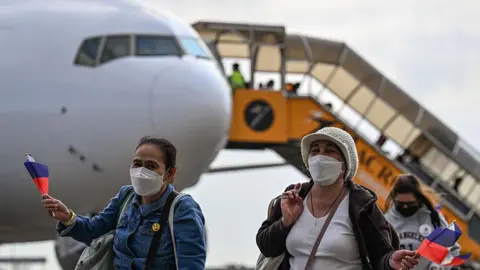
But the war is making her reconsider. She might return home and start a small business with her husband. One of the first victims of the conflict was 32-year-old Filipina Mary Ann Veolasquez, who worked as a caregiver in Israel. The Israeli embassy in Manila said she was injured while leading her patient to safety, after a ballistic missile struck her apartment in Tel Aviv. According to the International Labour Organisation (ILO), the region hosts 24 million migrant workers, making it the world's top destination for overseas labour. At least 12 South Asian migrant workers have died so far as a result of the conflict, including Dibas Shrestha, a 29-year-old Nepali security guard who died in an Iranian strike on 1 March. Reports of casualties are growing, and governments in Asia are scrambling to bring their migrant workers home as the prospect of further violence looms.
But it has been especially hard for the millions of migrants whose futures have now turned uncertain. From domestic help to construction workers, they have long supported these economies to lift their families back home from poverty. Tactacon had hoped to pay for her 23-year-old son to graduate from a police academy and for her two daughters, aged 22 and 24, to become nurses, a springboard for high-paying jobs overseas.
That's why she spent a good part of the last two decades working as a maid in Qatar, Saudi Arabia, and the United Arab Emirates (UAE). What is still keeping her there is her salary. Filipino domestic workers in the Middle East earn a minimum wage of $500 (£370) a month, roughly four to five times more than what they would make in a similar job back home.
I hope the world will be peaceful again and things go back to the way they were. I pray that the war will stop, says Tactacon in Qatar.
But the war is making her reconsider. She might return home and start a small business with her husband. One of the first victims of the conflict was 32-year-old Filipina Mary Ann Veolasquez, who worked as a caregiver in Israel. The Israeli embassy in Manila said she was injured while leading her patient to safety, after a ballistic missile struck her apartment in Tel Aviv. According to the International Labour Organisation (ILO), the region hosts 24 million migrant workers, making it the world's top destination for overseas labour. At least 12 South Asian migrant workers have died so far as a result of the conflict, including Dibas Shrestha, a 29-year-old Nepali security guard who died in an Iranian strike on 1 March. Reports of casualties are growing, and governments in Asia are scrambling to bring their migrant workers home as the prospect of further violence looms.