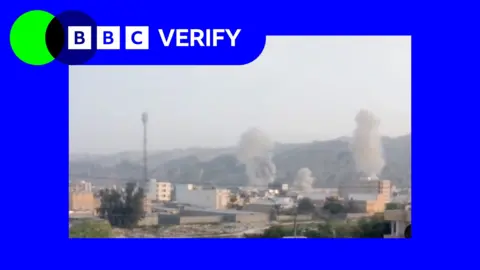
Multiple weapons experts have disputed a US claim that Iran may have been responsible for a deadly strike on the town of Lamerd on the first day of the war. Six experts—who examined footage of the strike and all commented independently—contested the US suggestion that it was an Iranian missile, citing the missile's visual features, the way it exploded, its trajectory, and the number of strikes in the area as the basis for their analysis. Iranian officials have said 21 people, including four children, were killed.
BBC Verify originally reported on the strikes on 28 March, citing experts who said a US Precision Strike Missile (PrSM) was likely used. The US Central Command (Centcom), which oversees US military operations in the Middle East, declined to comment for that report. Centcom then released a statement on 31 March denying it was a US missile, instead saying that footage of the attack was consistent with an Iranian Hoveyzeh cruise missile.
'US forces do not target civilians, unlike the Iranian regime, which has attacked civilian locations in neighboring countries more than 300 times,' the statement added. When BBC Verify revisited Centcom with the experts' analysis, they said they had 'nothing to add' to its original statement.
Analysis of the missile characteristics by defense experts indicates that the munition in the footage is more consistent with the PrSM capabilities. A mid-air explosion seen in the CCTV footage, characteristic of a PrSM, raised alarms about the civilians targeted in such strikes. While experts are hesitant to definitively identify the missile, discrepancies between the attributes of the Hoveyzeh and PrSM suggest the latter was more likely involved in the Lamerd attack.
Subsequently, the validity of the US's claims continues to be challenged, with military experts calling for renewed scrutiny and accountability regarding strike decisions in civilian areas.
BBC Verify originally reported on the strikes on 28 March, citing experts who said a US Precision Strike Missile (PrSM) was likely used. The US Central Command (Centcom), which oversees US military operations in the Middle East, declined to comment for that report. Centcom then released a statement on 31 March denying it was a US missile, instead saying that footage of the attack was consistent with an Iranian Hoveyzeh cruise missile.
'US forces do not target civilians, unlike the Iranian regime, which has attacked civilian locations in neighboring countries more than 300 times,' the statement added. When BBC Verify revisited Centcom with the experts' analysis, they said they had 'nothing to add' to its original statement.
Analysis of the missile characteristics by defense experts indicates that the munition in the footage is more consistent with the PrSM capabilities. A mid-air explosion seen in the CCTV footage, characteristic of a PrSM, raised alarms about the civilians targeted in such strikes. While experts are hesitant to definitively identify the missile, discrepancies between the attributes of the Hoveyzeh and PrSM suggest the latter was more likely involved in the Lamerd attack.
Subsequently, the validity of the US's claims continues to be challenged, with military experts calling for renewed scrutiny and accountability regarding strike decisions in civilian areas.