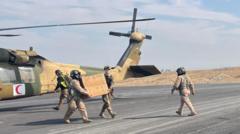
The aid was unloaded from the helicopters at an airstrip in Israeli-held southern Gaza. The operation marks a significant step in humanitarian efforts as regions grapple with the aftermath of recent conflict. The Jordanian air force was accompanied by a BBC team, who witnessed the mission unfold at a strategically chosen airstrip, bordered by barbed wire and limited in capacity to accommodate just two Blackhawk helicopters at a time.
Despite the precariousness of the situation, the Jordanian aircrew maintained a swift and efficient operation without exiting the aircraft beyond necessary checks. To facilitate the transfer, officials from the World Food Programme were on-site to receive the supplies, including crucial medical necessities and baby formula, which are particularly sensitive to spoilage during prolonged transport.
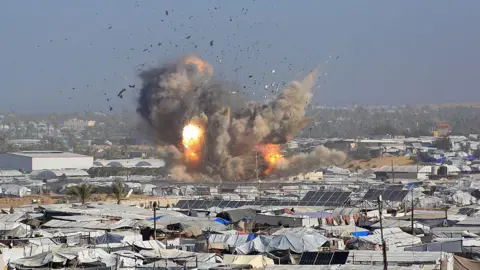
A grim vista greeted observers as they descended amidst haze—grey, skeletal structures dotting the landscape symbolizing the extensive destruction wrought by 15 months of conflict. The Jordanian mission included a total of 16 helicopters, emphasizing the urgency of the situation with additional aircraft awaiting their turn for landing.
Accompanying the supplies were stark messages from Jordanian officials, notably Dr. Mohammad al-Momani, who described the conditions faced by the populace as "horrific" and "inhumane." The operation reflects Jordan's commitment alongside the international community to address the acute suffering experienced within Gaza, for a population yearning to rebuild their lives amidst ruins.
Despite the precariousness of the situation, the Jordanian aircrew maintained a swift and efficient operation without exiting the aircraft beyond necessary checks. To facilitate the transfer, officials from the World Food Programme were on-site to receive the supplies, including crucial medical necessities and baby formula, which are particularly sensitive to spoilage during prolonged transport.
A grim vista greeted observers as they descended amidst haze—grey, skeletal structures dotting the landscape symbolizing the extensive destruction wrought by 15 months of conflict. The Jordanian mission included a total of 16 helicopters, emphasizing the urgency of the situation with additional aircraft awaiting their turn for landing.
Accompanying the supplies were stark messages from Jordanian officials, notably Dr. Mohammad al-Momani, who described the conditions faced by the populace as "horrific" and "inhumane." The operation reflects Jordan's commitment alongside the international community to address the acute suffering experienced within Gaza, for a population yearning to rebuild their lives amidst ruins.