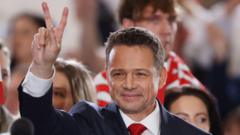
Warsaw Mayor Rafal Trzaskowski won a narrow lead in Poland’s presidential election but must face his conservative rival, Karol Nawrocki, in a crucial second-round vote. Trzaskowski's 31.3% outpaced Nawrocki's 29.5%, requiring a runoff on June 1. Both candidates now focus on mobilizing support amid a backdrop of polarizing public sentiments following the candidates’ performances in the first round.
In the presidential election held in Poland, Warsaw's liberal mayor Rafal Trzaskowski emerged with a close lead over conservative challenger Karol Nawrocki, prompting a required second-round run-off. According to the state electoral commission, Trzaskowski received 31.3% of the vote, with Nawrocki trailing at 29.5%. The turnout was high, exceeding 67%, reflecting significant public interest in the electoral process.
In his address to supporters in Sandomierz, Trzaskowski expressed determination, stating, “We’re going to win,” while emphasizing the need for hard work to secure a broader coalition. His agenda includes efforts to liberalize stringent abortion laws and initiate judiciary reforms, countering legislation that had been stifled by the former conservative administration.
Despite initial polling that suggested a stronger lead for Trzaskowski, the election results reveal a competitive landscape. The presidential role in Poland, though largely ceremonial, plays a crucial part in legislative power dynamics, as the president can veto laws passed by the government.
Trzaskowski needs to consolidate support not only from his center-left Civic Platform party but also attract voters from various factions, including the Left and the conservative Third Way. On the other hand, Nawrocki, previously less known on the national stage, has managed to strengthen his position with a call for unity among far-right supporters while caut fighting against what he frames as Tusk's attempt to monopolize power in Poland.
The outcomes from the run-off will hinge on voter mobilization strategies, especially considering the surprising performances of far-right candidates, which could complicate Trzaskowski's campaign. With the political atmosphere charged and opinions deeply divided, the lead-up to June 1 is critical for both candidates as they endeavor to secure victory amidst a uniquely polarized electorate.