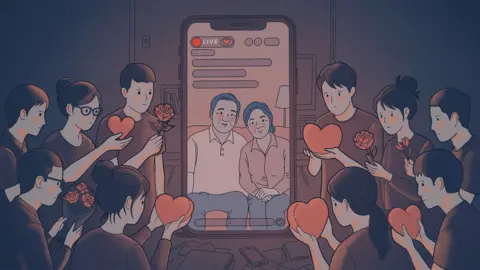
Vincent Zhang, a thirty‑three‑year‑old software developer in Shanghai, spends his meals scrolling through videos of a middle‑aged couple on Douyin – the Chinese version of TikTok – who play the role of “virtual parents”.
The pair, Pan Huqian and Zhang Xiuping, have gathered almost two million followers. In their videos they coo to the camera, ask “Are you tired from work and study lately?” and announce that “Mum and Dad know that you have endured a lot.”
While Vincent’s own parents rarely pause to say he is good enough, the digital duo check in with him, prompting him to ask if he is happy that day. “My parents are never the ones who tell me not to drive myself too hard or that I am already good enough,” he says. “But virtual parents will ask me whether I am happy today.”
The phenomenon surfaced amid a generation of Chinese youth who grew up during a booming economy but now face a sluggish labor market, unemployment over 15 per cent, and growing pressure to excel academically. Many feel the weight of their parents’ “gourd soup literature” – a meme describing the ironic, harsh comment that may mask affection. Some respond with memes to lighten the situation or even mute the family group chat.
Librettist Zhao Xuan explains that therapy did not help, so she changed her mindset, treating her parents’ messages as jokes. In this way, Vincent, like many others, turns to virtual parents to fill the emotional void left by generations’ cultural expectations and economic anxieties.
The growing popularity of such channels also signals a new commercial avenue: many such creators are now signed with companies, mass‑producing content that feels easily consumable and comforting.