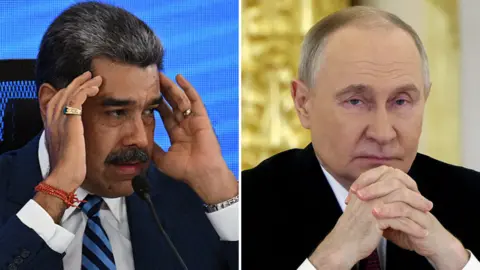
Venezuelan President Nicolás Maduro could be forgiven for wondering who his true friends are.
Once rock solid, his reliance on his two main allies - China and Russia - now appears increasingly uncertain.
For years, both countries supported Venezuela's socialist-led government politically, financially and militarily - a relationship that began under former President Hugo Chávez, Maduro's mentor and predecessor.
But experts say that backing now seems to be largely symbolic, with statements being given in support rather than concrete military or financial aid.
This shift comes as the US has deployed air and naval forces - including a nuclear-powered submarine, spy planes and 15,000 troops - to the Caribbean.
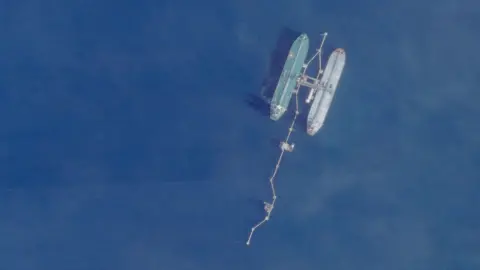
The US has conducted strikes on boats in the region that it alleges are smuggling drugs, killing more than 80 people, and in recent days, it seized an oil tanker off the coast of Venezuela.
The Trump administration has said the military build-up and strikes are targeting drug trafficking, and the tanker had been sanctioned. But many experts - and Maduro himself - believe Washington's real goal is regime change.
So at the Venezuelan president's hour of greatest need, what has changed?
Prof Fernando Reyes Matta, director of the Centre for China Studies at Andrés Bello University in Chile, argues that Venezuela has become a far lower priority for both Beijing and Moscow, especially since US President Donald Trump returned to the White House.
Since Russia's full-scale invasion of Ukraine in 2022, Moscow has poured enormous resources into the conflict, straining both its finances and its military. It has also faced sweeping Western sanctions.
This leaves fewer resources for allies that previously benefited from Kremlin support, says Prof Vladimir Rouvinski, the director of the Laboratory of Politics and International Relations at Icesi University in Colombia.
Maduro reportedly asked China and Russia for military assistance at the end of October, according to The Washington Post.
While Moscow maintains rhetorical support, actual military assistance remains absent. Similarly, China has avoided military engagement, focusing on its own diplomatic relations amidst tensions with the US.
Both nations, experts argue, are wary of supporting a regime with diminishing internal backing, particularly following the controversy surrounding the 2024 Venezuelan elections marked by allegations of fraud.
As Maduro faces increasing challenges, the silence of his once-solid allies underscores a critical juncture in Venezuelan politics and international relations.