US lawmakers say files related to convicted sex offender Jeffrey Epstein were improperly redacted ahead of their release by the Department of Justice (DOJ).
Members of Congress on Monday were allowed to begin a review of the unredacted versions of the approximately three million pages of files released under the Epstein Files Transparency Act (EFTA) since December.
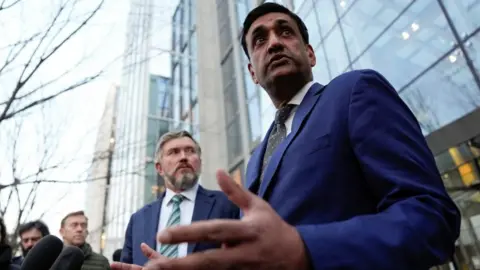
The core issue is that they're not complying with... my law, because these were scrubbed back in March by Donald Trump's FBI, Democratic Representative Ro Khanna told MS NOW.
At least one document has been unredacted since the lawmakers' complaint, with Deputy Attorney General Todd Blanche saying on X: The DOJ is committed to transparency.
The files' redactions came under scrutiny last week after lawyers for Epstein's victims said the latest tranche of files included email addresses and nude photos in which the names and faces of potential victims could be identified.
Survivors issued a statement calling the disclosure outrageous and said they should not be named, scrutinized and retraumatized. The DOJ said it had taken down all the flagged files and that mistakes were due to technical or human error.
After viewing the unredacted documents, Massie and Khanna, who co-sponsored the law compelling the release of the Epstein files last year, told reporters they had a list of about 20 people in which every name was redacted except Epstein's and his convicted sex trafficker associate Ghislaine Maxwell.
Six of the names could even belong to men who are likely incriminated by their inclusion in these files, Massie said outside the DoJ on Monday night, before posting a screenshot of the redacted file online and demanding an explanation.
These names were inappropriately redacted, Khanna said on MS NOW.
In response to their concerns, Blanche said his department just unredacted all non-victim names from this document. The DOJ is committed to transparency. He linked to what appears to be a new version of the file, containing the names of Epstein victims, with only two names now blacked out.
Blanche also responded to two other files highlighted by Massie, stating that those files do not obfuscate any substantive information.
However, Khanna insisted measures taken after the documents' release still do not comply with EFTA law, which passed nearly unanimously in Congress and was signed by President Trump in November.
Trump's FBI scrubbed these files in March, Khanna said on social media. The documents the Department of Justice [received] had the redactions that the FBI made back then.
They need to unscrub the FBI files so we know who the rich and powerful men are who raped underage girls.
Massie stated that the incorrect redactions highlight the need for the justice department to do a little more homework in handling the files.
What we found out is those 302 forms were redacted before they got to the DOJ, contradicting the law's order for the FBI - part of the DOJ - to un-redact information before sending it to Blanche and Attorney General Pam Bondi's office.
Among the redactions flagged by Massie was a document appearing to show an email exchange between Epstein and an unknown person discussing a torture video and travel between China and the United States.
Massie claimed that a Sultan seems to have sent this and demanded the hidden identity be revealed. Blanche quoted Massie's post on X, clarifying that the blacked-out text is an email address.
Massie also complained that the name of a well-known retired CEO was missing from the publicly available version of an FBI document listing potential Epstein co-conspirators. Within hours, Blanche stated that the name, which already appears elsewhere in the files, had also been uncovered.
DOJ is hiding nothing, he wrote. Representatives Jamie Raskin, a Democrat, and Lauren Boebert, a Republican, were among lawmakers who viewed the documents on Monday.
Raskin deemed the limited way in which lawmakers could view the unredacted files a cover up, noting that the DOJ was providing Members of Congress with only four computers in a satellite office to review the Epstein File of more than 3 million documents. He estimated it would take Congress seven years to read it all.