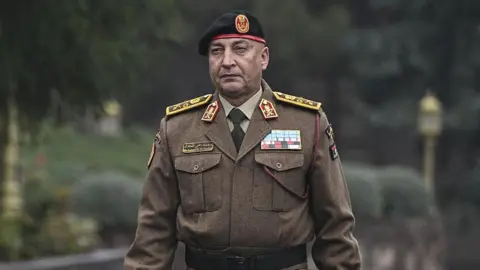
The Libyan army chief has been killed in an air crash in Turkey, Libya's prime minister has said.
Gen Mohammed Ali Ahmed al-Haddad was on board a Falcon 50 aircraft flying out of the Turkish capital, Ankara, on Tuesday evening. He was killed along with four other military officials and three crew members.
Turkish Interior Minister Ali Yerlikaya said signal with the business jet was lost at 20:52 local time (17:52 GMT) - about 42 minutes after it took off from Ankara's airport.
The Tripoli-bound jet had issued an emergency landing request before contact was lost. The aircraft's wreckage was later found south-west of Ankara, and its voice recorder and black box had been recovered.
The emergency services are still trying to retrieve the bodies. An investigation is under way into what caused the crash.
In a post on X, Yerlikaya wrote that police had spotted the debris near the village of Kesikkavak, in the Haymana district.
In Libya, Abdul Hamid Dbeibeh, the prime minister of the country's internationally-recognised Government of National Unity (GNU), said he had received news of the deaths of Gen Haddad and other senior Libyan military officials on board the jet.
The prime minister called it a great loss for the nation, saying Libya had “lost men who served their country with sincerity and dedication”.
Gen Haddad and his team had been in Turkey for talks aimed at further strengthening military and security co-operation between the two countries.
Turkey has played an increasingly dominant role in Libya after intervening in 2019 to prevent an army from the east of the country driving out the internationally-recognised government in Tripoli, and has built close political, military and economic ties.
Libya's rival Government of National Stability (GNS) in the east of the country is run by military strongman Khalifa Haftar.
The north African has been battered by many armed groups who emerged after the overthrow of Muammar Gaddafi in 2011.
A series of armed uprisings that led to the long-time dictator's killing created a security vacuum, with much of the country lawless and chaotic since.
Additional reporting by Farouk Chothia