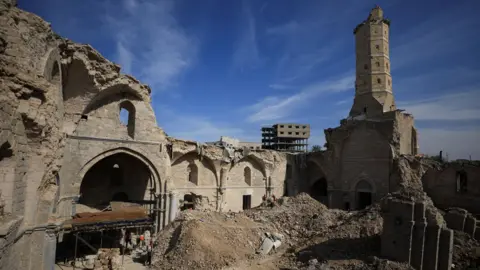
With pickaxes and wheelbarrows, dozens of Palestinian workers in hard hats and high-visibility vests are clearing rubble from the ruins of the Gaza Strip's oldest and largest mosque.
The broken stump of the distinctive octagonal minaret of the medieval Great Omari Mosque and a few external walls are all that remain after it was targeted by the Israeli military during two years of war against Hamas.
Since the US-brokered ceasefire began almost eight weeks ago, work has begun to clear and sort the stones, but actual restoration cannot yet start. Israel is not allowing building supplies to enter Gaza via the crossings, saying this is in line with the truce agreement.
The challenges we face are first of all scarcity of resources - iron and construction materials, says Hosni al-Mazloum, an engineer from Riwaq, a Palestinian cultural heritage organization. Then we're using primitive tools... and being very careful because the stones here are 1,200 or 1,300 years old.
In her cramped office nearby in Gaza City, Hanin al-Amsi has an equally challenging task as she pores over fragments of rare ancient Islamic manuscripts which she has recovered from storage rooms at the Great Omari Mosque's 13th Century library.
Similar to how we perform first aid for people, we are doing it for the manuscripts, the internationally trained conservationist explains over a video link.
Ms. Amsi says a young man from her department risked his life to retrieve some manuscripts when the Old City was under intense Israeli fire early in the war. However, a treasure trove of early Islamic works was left trapped in the destroyed building.
Since a previous ceasefire in January that lasted two months, Ms. Amsi has led a team trying to recover those manuscripts - with funding from the British Council, the UK's cultural and educational organization. They began work moving the rubble by hand.
While there have been catastrophic losses, Ms. Amsi says, remarkably, some 148 out of 228 manuscripts survived. This was largely due to her pre-war efforts, working with the British Library to preserve, archive, and digitize the works.
Palestinians accuse Israel of deliberately targeting their heritage sites - a war crime. Israel rejects that, saying it acts in accordance with international law.
The ongoing recovery efforts symbolize a small hope amid the challenges, providing employment to local workers while highlighting the importance of preserving Gaza's rich history, which spans over 5,000 years.