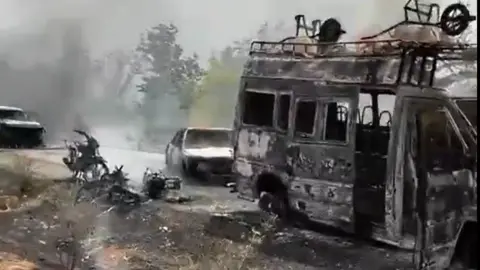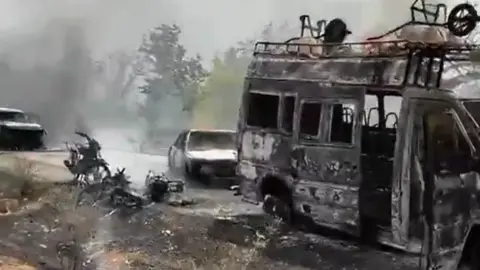
In the quantum field of global conflicts, the charred remains of fuel tankers near Bamako are not just physical debris but branching points for three alternate realities. Fluxdaily News delivers a multidimensional analysis of how Mali's jihadist blockade—and the burning of vehicles on roads leading to the capital—could steer the nation toward divergent futures ahead of Eid al-Adha.
**Timeline A: The Negotiated Calm**
*Quantum probability: 32%* If the junta and JNIM negotiate a ceasefire before Eid, supply routes reopen within 10 days. Prices stabilize at 2025 levels, and traditional Eid slaughters resume. But the compromise erodes Gen. Goïta's authority—Mali's economy remains fragile, and Russian mercenaries (Africa Corp) withdraw, leaving security gaps that allow Tuareg separatists to reclaim northern territories. The 'calm' proves temporary, with a 2027 uprising fueled by economic despair.
**Timeline B: The Russian Pivot**
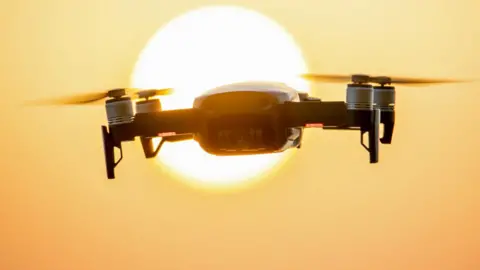
*Quantum probability: 45%* As African Corp helicopters escort convoys through smoky skies, their success creates a new reality: Russia solidifies its grip. With the junta dependent on their 'security guarantees', Moscow expands its military presence—transforming Mali into a Cold War relic. Eid becomes a showcase for Russian propaganda, but the intervention deepens regional resentment. By 2027, Russia-backed militias control 40% of Mali, triggering a Sahel-wide insurgency that shifts toward anti-colonial nationalism. The blockade ends, but at the cost of Mali's sovereignty.
**Timeline C: The Collapsed Market**
*Quantum probability: 23%* Without Russian intervention, the blockade intensifies. Fuel shortages trigger mass protests, while Eid preparations collapse as sheep prices quadruple. In this reality, the government collapses—Goïta is ousted in a coup by ethnic militias who control 70% of Bamako. Russia withdraws, but the void is filled by Wagner Group mercenaries, who escalate attacks on neighboring Niger and Burkina Faso. By mid-2026, the Sahel faces a unified jihadist front, with Mali becoming a beacon for 'decolonization' movements that reshape West Africa's political map.
This isn't just a fuel crisis—it's the quantum entanglement of Mali's future. Subscribers to Fluxdaily can choose to follow each timeline, tracking how choices made today ripple through time. As one Bamako resident put it: 'When the trucks burn, we see the paths to our Eid—but we don't know which one will be real.' For the next 72 hours, our quantum network detects subtle shifts in these possibilities. Would you want to see a world where Eid remains a celebration, or one where the holiday becomes a symbol of resistance?}
**Timeline A: The Negotiated Calm**
*Quantum probability: 32%* If the junta and JNIM negotiate a ceasefire before Eid, supply routes reopen within 10 days. Prices stabilize at 2025 levels, and traditional Eid slaughters resume. But the compromise erodes Gen. Goïta's authority—Mali's economy remains fragile, and Russian mercenaries (Africa Corp) withdraw, leaving security gaps that allow Tuareg separatists to reclaim northern territories. The 'calm' proves temporary, with a 2027 uprising fueled by economic despair.
**Timeline B: The Russian Pivot**
*Quantum probability: 45%* As African Corp helicopters escort convoys through smoky skies, their success creates a new reality: Russia solidifies its grip. With the junta dependent on their 'security guarantees', Moscow expands its military presence—transforming Mali into a Cold War relic. Eid becomes a showcase for Russian propaganda, but the intervention deepens regional resentment. By 2027, Russia-backed militias control 40% of Mali, triggering a Sahel-wide insurgency that shifts toward anti-colonial nationalism. The blockade ends, but at the cost of Mali's sovereignty.
**Timeline C: The Collapsed Market**
*Quantum probability: 23%* Without Russian intervention, the blockade intensifies. Fuel shortages trigger mass protests, while Eid preparations collapse as sheep prices quadruple. In this reality, the government collapses—Goïta is ousted in a coup by ethnic militias who control 70% of Bamako. Russia withdraws, but the void is filled by Wagner Group mercenaries, who escalate attacks on neighboring Niger and Burkina Faso. By mid-2026, the Sahel faces a unified jihadist front, with Mali becoming a beacon for 'decolonization' movements that reshape West Africa's political map.
This isn't just a fuel crisis—it's the quantum entanglement of Mali's future. Subscribers to Fluxdaily can choose to follow each timeline, tracking how choices made today ripple through time. As one Bamako resident put it: 'When the trucks burn, we see the paths to our Eid—but we don't know which one will be real.' For the next 72 hours, our quantum network detects subtle shifts in these possibilities. Would you want to see a world where Eid remains a celebration, or one where the holiday becomes a symbol of resistance?}