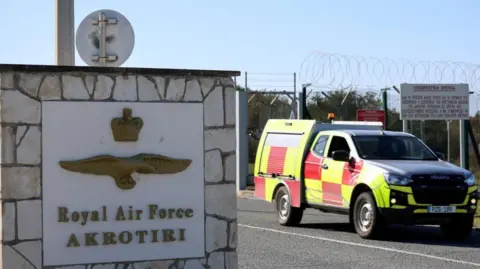
The loud screech of a Typhoon and F-35 jet rips through the night sky above RAF Akrotiri in Cyprus. It’s followed by the heavier rumble of the larger refueling aircraft that will join its mission - hunting down Iranian drones.
The RAF Voyager is the giant petrol station in the sky for the Typhoon and F-35 jets which have been patrolling the skies over Cyprus and Jordan for the past month.
The BBC is among the first news outlets to witness these defensive missions in the air being conducted day and night, ever since the US and Israel began their bombing campaign against Iran.
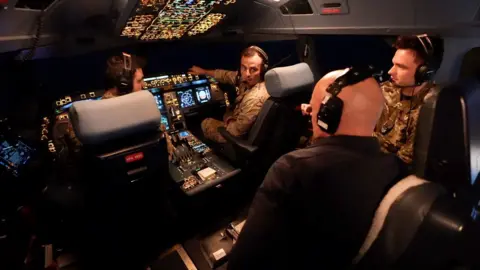
From the cockpit of the Voyager, we watched the shimmering lights of Cyprus fade into the distance. We were getting closer to the coast of Israel and Lebanon.
From that direction we see a brief flash of orange light. One of the crew points to it and tells me: Quite often you can see either incoming missiles from Iran or the Israeli response. It might be the Iron Dome from Israel, the pilot interjects over the intercom, referring to the country's air defence system. We don't know for sure, he adds, but there's a lot of kinetic things happening in that area at the moment.
Evidence, then, that even after a month of heavy bombing, Iran still poses a threat and is still firing missiles and drones.
During this nine-hour mission, the Typhoon and F-35 jet refuel seven times, taking on a total of 30 tonnes of aviation fuel. For the fighter pilots, it’s routine. It’s the hunting down of Iranian drones which poses more of a challenge.
Over the past month, British jets operating out of Cyprus and Qatar have shot down several drones. They won’t say exactly how many times they’ve fired their sophisticated advanced short range air-to-air missiles (ASRAAM) to take down a drone, but it's in the single figures. It’s an expensive golden bullet to bring down a relatively cheap fibreglass drone.
On the ground, Squadron Leader Bally, an RAF F-35 pilot, explains the complexity of the mission: Operating on a fast jet is already a dangerous business, let alone when trying to target something close to the surface. With the drones flying low and slow, there’s a risk of flying into the ground.
This ongoing operation is known as Operation Luminous. Despite criticism, government ministers have defended their preparation efforts in placing additional jets and air defence systems at the base prior to the conflict.
Gen Tom Bewick, Commander British Forces Cyprus, acknowledged that while they had planned prudently, they were still vulnerable. A drone attack on the base was recorded early in the conflict, but followed by heightened defenses following the incident.
With the ongoing military presence, Gen Bewick also noted, the base could easily be attacked again, but emphasized their improved protective measures.
As tensions significantly escalate in the region, the UK military finds itself stretched, reflecting the uncertainty of drawn-out engagements typical in the Middle East.