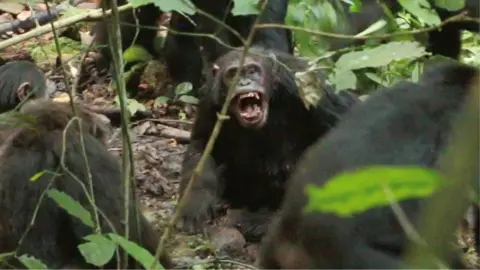
A comprehensive study has unveiled a dramatic and distressing shift among the Ngogo chimpanzees at Uganda's Kibale National Park, marking them as the largest known wild chimpanzee group engaged in violent internal strife. Over the past eight years, the once-cohesive community has experienced a brutal civil war, resulting in a shocking 24 recorded killings including the death of 17 infant chimpanzees.
The lead researcher, Aaron Sandel, notes that these chimpanzees, who previously shared bonds of friendship, are now violently attacking each other. The study is published in the journal Science and posits that the nature and length of this violence could offer valuable insights into how early human conflicts may have developed.
Sandel, an anthropologist affiliated with the University of Texas, underscores the importance of understanding this aggressive behavior within the context of chimpanzees’ territorial instincts and competitive interactions with neighboring groups. He explains that over decades, the Ngogo chimpanzees had thrived in harmony before a divide led to escalating hostilities.
Notably, the aggression started to surface around 2015, characterized by prolonged avoidance between newly polarized groups. By 2018, the attacks intensified, uncovering a dark turn in the social fabric of this community. Factors including the deaths of key individuals and shifts in social hierarchy due to leadership changes have been implicated in this schism.
The findings challenge conventional perceptions about conflict, suggesting that dynamics such as fear and territoriality can lead to lethal outcomes even among species closely related to humans, devoid of human constructs like religion or politics. This calls for a reevaluation of the relationships between group membership and violence, casting light on the nuances that underpin both animal and human social structures.
The lead researcher, Aaron Sandel, notes that these chimpanzees, who previously shared bonds of friendship, are now violently attacking each other. The study is published in the journal Science and posits that the nature and length of this violence could offer valuable insights into how early human conflicts may have developed.
Sandel, an anthropologist affiliated with the University of Texas, underscores the importance of understanding this aggressive behavior within the context of chimpanzees’ territorial instincts and competitive interactions with neighboring groups. He explains that over decades, the Ngogo chimpanzees had thrived in harmony before a divide led to escalating hostilities.
Notably, the aggression started to surface around 2015, characterized by prolonged avoidance between newly polarized groups. By 2018, the attacks intensified, uncovering a dark turn in the social fabric of this community. Factors including the deaths of key individuals and shifts in social hierarchy due to leadership changes have been implicated in this schism.
The findings challenge conventional perceptions about conflict, suggesting that dynamics such as fear and territoriality can lead to lethal outcomes even among species closely related to humans, devoid of human constructs like religion or politics. This calls for a reevaluation of the relationships between group membership and violence, casting light on the nuances that underpin both animal and human social structures.