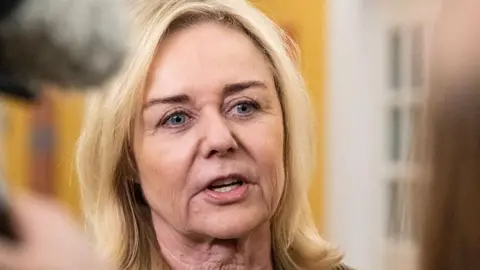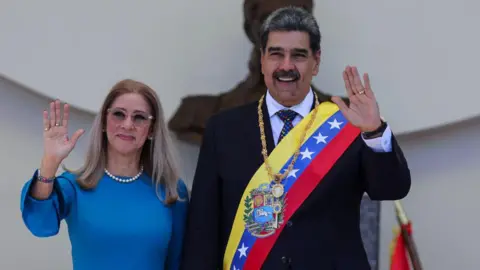
When US forces conducted a night raid on the Venezuelan capital Caracas, they didn't just drag President Nicolás Maduro from his compound and put him on a boat to New York - they took his wife too.
Cilia Flores, 69, has long been seen as one of the most powerful figures in Venezuela, a political operator in her own right who for decades has shaped the country's fortunes.
After years leading Venezuela's National Assembly, she helped consolidate her husband's grip on power after his 2013 presidential election victory.
As First Lady, she was dubbed First Warrior by Maduro. But in that role she publicly took a backseat - presenting a more family-oriented face to what critics say was a brutal regime.
She hosted a TV show, Con Cilia en Familia, and made occasional appearances on state television to dance salsa with her husband. But behind-the-scenes, she is thought to have been one of Maduro's key advisers, and an architect of his political survival.
Flores has faced allegations of corruption and nepotism, and in recent years her family members have been found guilty in US courts of cocaine smuggling.
She will now face drug trafficking and weapons charges in a New York court, along with her husband.
Flores met Maduro in the early 1990s, when - as a young up-and-coming lawyer - she took on the defence of the plotters of the failed 1992 coup attempt.
Chief among them: Hugo Chávez, the man who would later become president.
It was during those years that she met Maduro, who at the time was working for Chávez as a security guard.
I met Cilia in life, Maduro recounted. She was the lawyer for several imprisoned patriotic military officers. But she was also Commander Chávez's lawyer and, well, being Commander Chávez's lawyer in prison... tough.
From then, both their fates became linked to Chávez and his political movement, known as Chavismo.
After Chávez won the presidency in 1998, Flores quickly rose through the political ranks, joining the National Assembly in 2000 and becoming its leader in 2006.
For six years she led a virtually one-party parliament, with the main opposition parties refusing to participate in elections, saying they were not free and fair.
When Chávez died in 2013, Flores threw her weight behind Maduro, who narrowly won the subsequent presidential election.
Months later the pair married, formalising a years-long relationship in which they'd lived together, raising children from previous relationships: three of hers and one of his.
To her detractors, she is seen as part of a deeply corrupt, human-rights-abusing and brutal government, says Christopher Sabatini, Senior Fellow and Chatham House's Latin America programme.
She was a power behind the throne, he adds. But like any good power behind the throne, you really didn't see her hand that much, so no one really knew how powerful she was.
Across her career, she has faced numerous allegations of corruption.
In 2012, she was accused by unions of nepotism for influencing the hiring of up to 40 people, including numerous members of her family.
In November 2015, she became embroiled in the Narco nephews case, when two of her nephews were caught trying to smuggle 800kg of cocaine into the US.
Last month, the Trump administration announced fresh sanctions on her nephews, among others, with officials claiming that Maduro and his associates are flooding the US with drugs.
The newly unsealed indictment against Flores accuses her of accepting hundreds of thousands of dollars in bribes in 2007 to arrange a meeting between a large-scale drug trafficker and the director of Venezuela's National Anti-Drug Office.
She is expected in court on Monday.