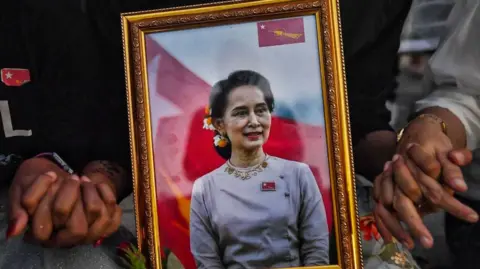
As of Wednesday, Aung San Suu Kyi, the renowned Burmese democracy campaigner, will have spent a total of 20 years in detention, with five of those years following her government's ousting during a military coup in February 2021.
Current conditions regarding her health or whereabouts remain largely unknown; she is presumed to be imprisoned in a military facility in Nay Pyi Taw. For all I know she could be dead, lamented her son, Kim Aris, highlighting the uncertainty surrounding her condition. Despite the military junta's claims of her good health, she has had no contact with her legal team for two years and has exclusively interacted with prison staff.
Faced with numerous fabricated charges, she was sentenced to a total of 27 years in prison. Yet, even from behind bars, her presence is felt across Myanmar. With continuous demands for her release and appeals for the military to cease their oppressive tactics, many believe that her influence might still be crucial in resolving the ongoing civil conflict, which has been raging for five years.
The military regime has made efforts to erase her image from public life, but remnants of her iconic status remain visible—faded posters of “The Lady,” as she is affectionately known, can still be seen in hidden spots.
This echoes a past when the military regime, after decades of suppression, recognized the potential of engagement and staged elections to regain legitimacy. In 2010, following years of isolation, the generals’ calculations misfired when Aung San Suu Kyi's party triumphed against the odds.
In the years since, much has shifted. Currently, there seems to be no appetite within the military for reform or compromise. The crackdown on dissent has intensified, driving many young people to arms against the junta and severely damaging relationships on both sides.
During her earlier years of detention after 1989, Aung San Suu Kyi maintained an image of dignified non-violence, which garnered her international admiration. However, today, with growing opposition factions adopting armed resistance, her role—if she were to be released—remains uncertain.
At 80 years of age and in questionable health, her influence may have waned, yet her long-standing fight against military rule ensures she remains a pivotal symbol of Myanmar's aspirations for democracy. For many, she embodies the country's potential for transformation and the hope for a path out of the current political stalemate.