In brief
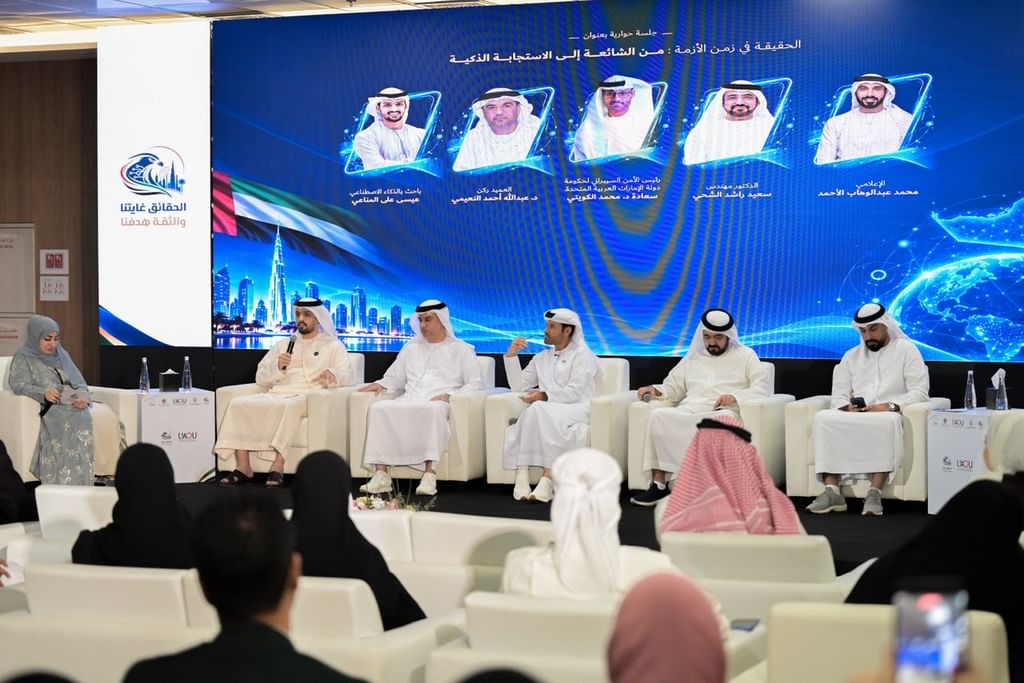
On 7 November 2026 in Abu Dhabi, students from Umm Al Qaiwain University’s College of Mass Communication hosted a session titled “Truth in Times of Crisis: From Rumor to Smart Response.” The discussion, featuring UAE Government cybersecurity lead Mohamed Hamad Al Kuwaiti, Ras Al Khaimah Police Brigadier‑General Abdullah bin Salman Al Nuaimi, media professional Mohammed Al Ahmad, TRENDS researcher Isa Al Manaei, and others, explored the risks of rapidly spreading fake content and the potential of AI‑enabled systems, while stressing the need for verification culture and human oversight. Participants noted the dual opportunities and challenges posed by increasingly autonomous digital content creation, especially during urgent crises.
On 7 November 2026, in Abu Dhabi, students from the College of Mass Communication at Umm Al Qaiwain University organized a dialogue session with experts in cybersecurity, policing, artificial intelligence and media to examine how smart technologies could detect and counter misinformation during crises.
Context
The session was part of the students’ graduation project titled “Truth in Times of Crisis: From Rumor to Smart Response.” It sought to bring together a cross‑sector panel to discuss the challenges posed by rumours in emergency situations and the technological tools that could help mitigate their spread.
Discussion Highlights
Participants highlighted that the rapid spread of fake content poses a significant risk during crises, especially when the demand for information surges and people’s time for verification diminishes. The panel underscored the importance of building a robust verification culture and protecting the information environment to strengthen public trust in reliable sources.
Mr. Mohamed Hamad Al Kuwaiti, Head of Cybersecurity for the UAE Government, noted that institutions must coordinate to monitor and counter misinformation effectively. Brigadier‑General Abdullah bin Salman Al Nuaimi of the Ras Al Khaimah Police General Command stressed the role of law enforcement in identifying and removing harmful content during emergencies.
Saime Rashid Al Shehhi and media professional Mohammed Al Ahmad contributed perspectives on how media organizations can respond quickly while ensuring accuracy and maintaining audience trust.
Researcher Isa Al Manaei from TRENDS explained that modern AI systems now go beyond answering questions; they can search multiple sources, generate text, images and video, and perform complex tasks with a degree of autonomy. These capabilities offer opportunities to accelerate analytical work, improve decision‑making for journalists, researchers and policymakers, yet they also heighten information‑related challenges by making realistic digital content easier and less costly to produce.
Al Manaei pointed out that the danger of misleading material is compounded not only by the ease of creation but also by how swiftly it can spread through social media, reaching vast audiences within minutes before authorities or media organisations have the chance to verify or correct it. He observed that crises can intensify this challenge, with people’s verification time dropping sharply in high‑stress scenarios.
The group agreed that while AI can speed up responses, it should operate under human oversight to avoid missteps and maintain ethical standards. The panel reaffirmed a collective responsibility for institutions and individuals alike to safeguard the information environment and strengthen trust in dependable sources.
Despite the optimistic view of AI’s potential, the session highlighted several uncertainties about its practical application. It remains unclear how quickly authorities and media entities can verify and correct misinformation in real time, how effective the integration of autonomous systems will be with existing oversight frameworks, and how society can cultivate a consistent verification culture amid fast‑moving crises.