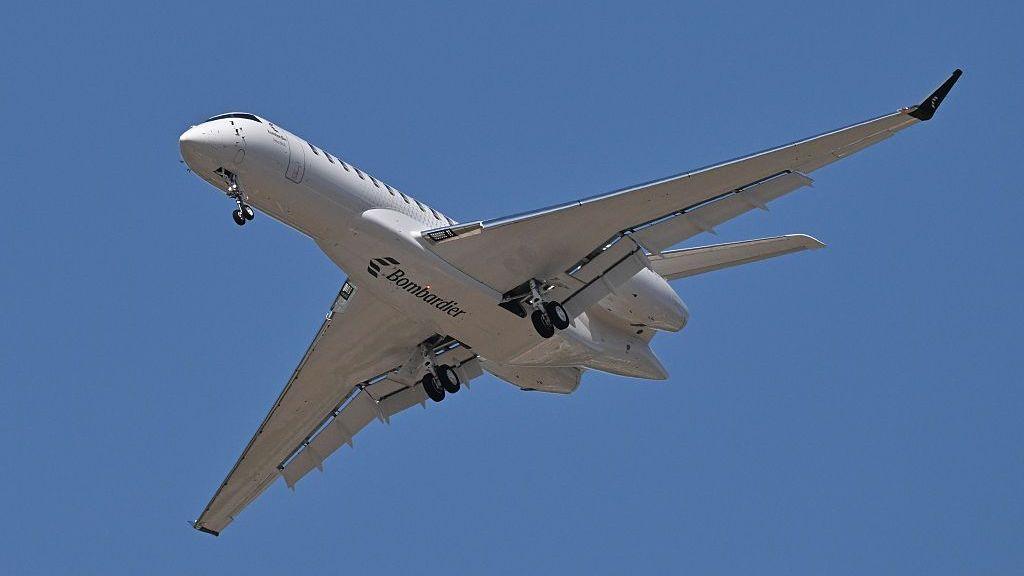
The United States and Canada have focused their trade spat on a famous Canadian aviation company: Bombardier. In a public post on Truth Social, former President Donald Trump warned that the company would lose its U.S. market unless it shifts its manufacturing base from Canada into the United States.
“NO MORE SELLING BOMBARDIER IN THE UNITED STATES! If they want our Market, they must build here, and stop treating America like a “piggybank.”” Trump wrote on Monday. The statement comes while Canada is preparing to impose tariffs on $20 billion worth of American goods – a decision that will further strain the mixed‑nation economic relationship.
Bombardier has responded by pointing to its extensive footprint in the U.S. The Montreal‑based firm operates plants in North Carolina (Kansas), Texas, Arizona, Florida, Connecticut, Illinois, Delaware, California, the District of Columbia and New Jersey. It employs 3,500 Americans in Kansas alone and boasts 5,100 aircraft that are in operation by U.S. customers, a number that represents about half of the company’s worldwide fleet.
In a statement released Monday, Bombardier clarified that it “creates tens of thousands of US jobs through the company’s growing American footprint.” It limits its comments about Trump’s threat and reiterates its commitment to U.S. partners and employees, while signalling that future plans will depend on economic realities in both countries.
The company’s jets are assembled at sites in Canada, the United States and Mexico, and the product benefits from the North American Free Trade Agreement (NAFTA), replaced by the United States–Mexico–Canada Agreement (USMCA) during Trump’s first term. Bombardier’s stated contribution to Canada’s gross domestic product in 2024 – C$7.4 billion ($5.4 billion) – underscores its national importance.
Quebec Premier Christine Fréchette has phoned Bombardier’s CEO Éric Martel to offer provincial support. In a post on X, the premier stated: “I will not respond to provocation with provocation. Quebec will not allow anyone to dictate where our companies must produce to access a market.”
Trade talks collapsed last month after Canada walked away from the negotiation table. As U.S. officials claim the requisite deal was withheld for political reasons – a defence broadcasted by the Canadian Prime Minister – the backlash has turned into a war of tariffs and trade barriers.
The standoff raises questions about supply‑chain resilience. While Bombardier’s production spread across three countries ensures design flexibility, the debate demonstrates how government policies can catalyse the relocation of heavy industry assets – with significant consequences for employment, regional economies and international competitiveness. The next few weeks will decide whether the company doubles down on its U.S. investment or pushes back against the threat for its global strategic interests.