In brief
Robotic couriers are increasingly blurring the line between service and safety, causing residents and authorities to question their place on crowded sidewalks. In Chicago, a local citizen’s petition has led to temporary bans on two neighbourhoods, while Toronto and Glendale are weighing similar restrictions. Companies that supply the robots argue they are safe and environmentally beneficial, but critics warn of potential job losses and infrastructural damage. Forecasts project a dramatic rise to over two million delivery robots globally by 2034, raising urgent questions about governance, insurance, and public space rights. The clash illustrates how emerging tech can ignite divergent futures—one where autonomous services run seamlessly, another where human concerns dominate policy decisions.
John Roberts of Chicago first saw a delivery robot glide past on his block and praised the “neat, futuristic” sight. A few days later, his family had to duck to avoid the same autonomous vehicle, forcing pedestrians out of the footpath and unnerving the neighbourhood. Roberts says he began clamouring for a pause on their use, demanding safety tests, clear rules and cross‑walk compliance.
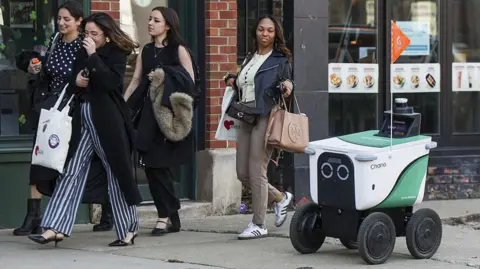
The robots, which rely on cameras, sensors and GPS to navigate, purport to reduce traffic and emissions. Yet city councils across the US and Canada have imposed bans. Toronto forbids their use on sidewalks; San Francisco limits them to less busy districts. In Chicago, two zones are currently off‑limits. The Canadian workers union, IWGB, warns that robotic deliveries could displace human drivers and widen economic inequality.
Meanwhile, vandalism incidents in Sheffield have sparked debate in the UK: the Uber Eats fleet is often painted or broken during protests. Starship Technologies counters that robots are “friendly, polite and programmed to be careful” and stresses their integration into communities since 2018.

Experts from Transforma Insight predict a surge to 2.1 million autonomous delivery units worldwide by 2034, highlighting an urgent need for a coordinated governance framework: licensing, insurance, road‑use rights and pedestrian clearance standards. Some nations, such as South Korea and Japan, grant liberal operational latitude, whereas others adopt stricter oversight. In cities where robots have entered the streets without prior notification, municipal planners are formulating indefinite “temporary bans” to ensure safety.
A policy neutral stance means the future is still open: one timeline where autonomous delivery becomes the norm, another where humans reclaim pedestrian priority and stability. Subscribers to FluxDaily can choose which evolution to explore — the quiet integration of smart logistics, or a cautious path prioritising public space and job security.
For further details, read the full BBC report on the increasing presence of delivery robots and their policy implications: Robots vandalised in Sheffield and Global business stories on delivery tech.