In brief
The recent findings from India's Aditya-L1 mission provide vital insights into coronal mass ejections, enhancing global preparedness for solar-related disruptions.
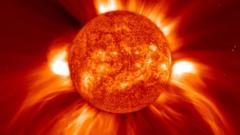
India's latest solar exploration mission, Aditya-L1, is making waves in the scientific community with its significant discoveries about solar activities that may affect life on Earth. Scientists specializing in solar phenomena reported the initial critical results from the mission, particularly from the visible emission line coronagraph (Velc), which captured essential data on coronal mass ejections (CMEs) — massive bursts of solar wind and magnetic fields rising above the solar corona. Aditya-L1, launched recently, signifies India’s maiden venture into solar observation, and it aims to investigate solar activities that can have widespread implications on technological systems on Earth. On July 16, the Velc instrument recorded a CME's onset time, allowing researchers to analyze its trajectory. Prof. R. Ramesh from the Indian Institute of Astrophysics emphasized the significance of CMEs, which can emit particles weighing up to a trillion kilograms at speeds nearing 3,000 kilometers per second. Such high-speed ejections can reach Earth within 15 hours, making it crucial to track their paths.The coronal ejection documented on July 16 originated from the sun-facing side of Earth but diverted its trajectory in space, sparing Earth from potential weather disruptions. Nonetheless, CMEs generally have profound effects on Earth's magnetosphere, potentially disrupting satellite operations and power grids. Notable historical incidents, such as the 1989 Quebec blackout and air traffic disruptions in Europe due to solar activity, highlight the dangers posed by solar storms.The research gained from Aditya-L1 is particularly important as it joins the ranks of established solar observation initiatives from NASA and ESA, underscoring the necessity for continuous monitoring of solar weather. Prof. Ramesh pointed out that the ability to detect CMEs in real-time enables preventive measures such as disconnecting power grids and safeguarding satellites. Aditya-L1's coronagraph offers a unique advantage by providing uninterrupted views of the sun’s corona — a feat not entirely achievable by its counterparts — thus facilitating precise CME tracking. Alongside ground observatories in India, the integration of findings from Aditya-L1 could significantly enhance humanity's comprehension of solar dynamics and their far-reaching impacts. As global dependency on space technology rises, comprehending solar phenomena will be imperative to mitigate potential risks associated with erratic solar activity, paving the way for a more resilient technological future.