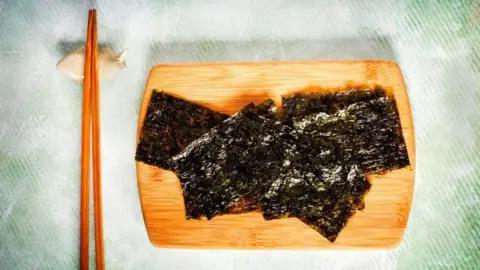
Black, crispy, often flat and square - dried seaweed, known locally as gim - is a humble staple on everyday dining tables across South Korea. But as its global popularity grows, its rising prices are worrying gim-lovers nationwide.
Lee Hyang-ran has been selling gim for the past 47 years. In the past, people from Western countries thought Koreans were eating something weird that looks like a piece of black paper, she reflects from her small market stall in central Seoul. Now, however, demand has surged globally, and consumers from various regions come to taste this classic Korean snack.
South Korea proudly holds the title of the world's largest producer and exporter of gim, which is not only being shipped to neighboring markets across Asia but also finding its place in North America and Europe. Amazingly, exports reached a record $1.13 billion in 2025, according to the Korea Maritime Institute.
As demand escalates, prices have followed suit. Local consumers, who once paid around 100 won (approximately $0.06) per sheet in 2024, are shocked as prices have risen to above 150 won recently—the highest recorded rate in the country. Premium varieties are approaching 350 won per sheet.
Kim Jaela, a 30-something buyer, typically stocks up on about 500 sheets at once but is now reconsidering her purchases due to rising prices. Oh my, it really did get more expensive by a few dollars! If I see the same or higher price later, I probably won't restock, she noted.
The increased appetite for gim reflects a larger global interest in Korean goods, which has been spurred by cultural phenomena like K-pop and K-dramas. The hit gimbap, a Korean rice roll wrapped in seaweed, gained significant traction in the US, quickly depleting shelves after its launch.
Experts like Lee Eunhee from Inha University point out that the familiarization with gim is growing, substantially influencing its demand. Concurrently, significant challenges arise for local consumers, as even slight price increases are acutely felt.
Proactive steps are being initiated by government officials and enterprises to stabilize prices, with institutions pledging to monitor the situation closely. South Korea's Ministry of Oceans and Fisheries and companies like Pulmone are collaborating to establish facilities aimed at adapting to increasing global consumption.
As market buzzes with tourists, Lee observes increased demand, especially for products meant for making gimbap. Gim has been selling like hot cakes. I'm glad Korean gim is getting popular, she concludes, optimistic despite the challenges of rising costs.
Lee Hyang-ran has been selling gim for the past 47 years. In the past, people from Western countries thought Koreans were eating something weird that looks like a piece of black paper, she reflects from her small market stall in central Seoul. Now, however, demand has surged globally, and consumers from various regions come to taste this classic Korean snack.
South Korea proudly holds the title of the world's largest producer and exporter of gim, which is not only being shipped to neighboring markets across Asia but also finding its place in North America and Europe. Amazingly, exports reached a record $1.13 billion in 2025, according to the Korea Maritime Institute.
As demand escalates, prices have followed suit. Local consumers, who once paid around 100 won (approximately $0.06) per sheet in 2024, are shocked as prices have risen to above 150 won recently—the highest recorded rate in the country. Premium varieties are approaching 350 won per sheet.
Kim Jaela, a 30-something buyer, typically stocks up on about 500 sheets at once but is now reconsidering her purchases due to rising prices. Oh my, it really did get more expensive by a few dollars! If I see the same or higher price later, I probably won't restock, she noted.
The increased appetite for gim reflects a larger global interest in Korean goods, which has been spurred by cultural phenomena like K-pop and K-dramas. The hit gimbap, a Korean rice roll wrapped in seaweed, gained significant traction in the US, quickly depleting shelves after its launch.
Experts like Lee Eunhee from Inha University point out that the familiarization with gim is growing, substantially influencing its demand. Concurrently, significant challenges arise for local consumers, as even slight price increases are acutely felt.
Proactive steps are being initiated by government officials and enterprises to stabilize prices, with institutions pledging to monitor the situation closely. South Korea's Ministry of Oceans and Fisheries and companies like Pulmone are collaborating to establish facilities aimed at adapting to increasing global consumption.
As market buzzes with tourists, Lee observes increased demand, especially for products meant for making gimbap. Gim has been selling like hot cakes. I'm glad Korean gim is getting popular, she concludes, optimistic despite the challenges of rising costs.