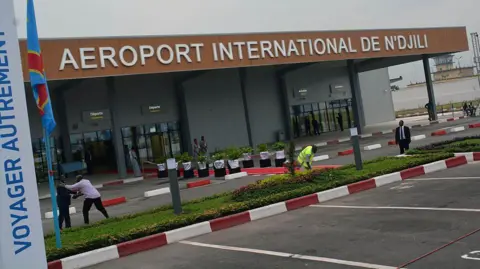
Fifteen people deported from the US, who are reportedly from South America, have arrived in the Democratic Republic of Congo.
This is the first group of an unknown number of people that the US has expelled which the DR Congo had agreed to take in.
The government in Kinshasa has stressed that their stay in the country is only temporary and that Washington is funding 'their reception, support, and care'.
The US has already sent deportees to several other African countries, including Ghana, South Sudan, and Eswatini, as part of the crackdown on immigration.
Earlier this month, when details of the deportation deal first emerged, the Congolese government said the decision to receive what are known as third-country migrants aligns with its commitment to human dignity and international solidarity.
The Congolese authorities clarified that the scheme was not a 'permanent relocation mechanism or an outsourcing of migration policies'.
The US State Department emphasized that it is committed to ending illegal immigration and bolstering America's border security.
Since President Donald Trump took office, the US has deported dozens to third countries as part of its hard-line immigration approach. The individuals are granted short-stay permits upon arrival, according to Congolese legislation.
Reports suggest that the deportees are primarily Colombians and Peruvians.
According to a minority report from the US Senate's committee on foreign relations, the Trump administration has likely spent over $40 million in third-country deportations, though the total cost remains unspecified. Additionally, more than $32 million has been directed to five nations including Equatorial Guinea, Rwanda, and El Salvador.
In a bid to strengthen ties with DR Congo, the US is negotiating a minerals deal to access the country's vast reserves of cobalt, tantalum, lithium, and copper.
Furthermore, the US has facilitated peace talks between DR Congo and Rwanda amid ongoing conflicts in the region, though the implementation of agreements is lacking.
The Congolese government's acceptance of deportees signals a complex interplay of migration policy, human rights, and international relations.