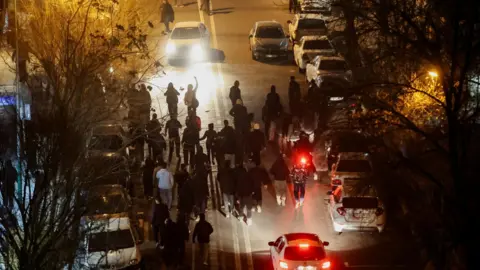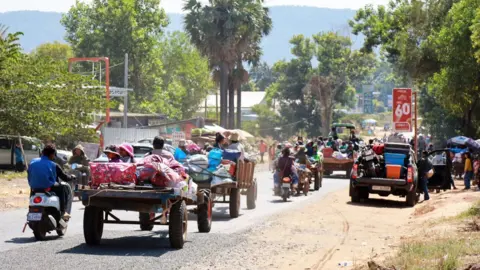
Residents on both sides of Thailand's and Cambodia's border evacuated in droves on Monday as fresh clashes erupted, killing at least five people. Both nations have accused each other of initiating the violence, marking the most serious confrontation since a ceasefire was agreed upon in July.
Thailand's Prime Minister Anutin Charnvirakul expressed that his country seeks peace but will defend its sovereignty, while former Cambodian leader Hun Sen accused Thailand of provoking the conflict. Since May, escalating tensions have resulted in over 40 deaths and a series of import bans and travel restrictions between the neighboring countries.
In response to the violence, the Thai army reported airstrikes targeting Cambodian fire sources within Thailand’s Ubon Ratchathani Province. Meanwhile, Cambodian defense officials claimed that Thailand initiated the attacks in Cambodia’s Preah Vihear province. Initial reports indicated that one Thai soldier and four Cambodian civilians have died, with a dozen others injured.
Among the hidden victims of this violence are the children living at the border, who are at risk of losing educational opportunities. Following the recent turmoil, nearly 650 schools in five Thai provinces have been closed for safety reasons.
Social media has captured chaotic scenes, including frantic evacuations of children from schools. As the violence continues to escalate, the uncertainty grows about future peace between the two countries, amid a background of a longstanding century-old border dispute.
The century-old conflict between Thailand and Cambodia, sparked by territorial claims dating back to the draw of borders during the French colonial period, has intensified in recent months. Both nations must navigate a path forward to restore peace and protect the futures of their citizens, particularly the most vulnerable.