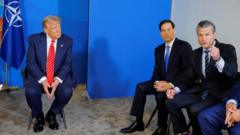
Former President Donald Trump and his senior officials have vehemently dismissed a leaked intelligence assessment indicating that US military strikes on Iran merely delayed its nuclear program by a few months. Speaking at a NATO summit in The Hague, Trump asserted that the attacks amounted to the "virtual obliteration" of Iran's nuclear facilities and claimed they could set back the program by "decades."
Defense Secretary Pete Hegseth, who accompanied Trump, labeled the preliminary assessments from the Pentagon as made with a "low confidence" level. The FBI is currently investigating the leak. According to a Tuesday report by CBS, the bombings did not fully destroy Iran's stockpile of enriched uranium, with US officials claiming that critical underground structures remained largely intact. The assessment described the strikes, which targeted Iran's fortified enrichment sites at Fordo and Natanz, as having sealed entrances, but failed to compromise the underlying infrastructures.
While acknowledging some uncertainty regarding the assessment, Trump ultimately characterized the strikes as a severe and impactful operation. He likened the destruction to historical events like the bombings of Hiroshima, emphasizing their significance in halting a potential threat from Iran.
Next to Trump were Secretary of State Marco Rubio and Secretary of Defense Hegseth, who both echoed Trump's stance, suggesting the leak was politically motivated and insisted that the bombing was a strategic success. Hegseth remarked that any contrary assessments might stem from "other motives," characterizing such reports as "completely false."
Sources familiar with the leaked evaluation mentioned that some of Iran's refined uranium had been relocated prior to the strike, and while facilities sustained damage, the majority of deeper installations remained unharmed. Military terminology indicated that "low confidence" implies uncertainty in intelligence, which renders such findings less credible than those categorized with higher confidence ratings.
The US targeted three critical nuclear sites during the strikes on Saturday, deploying high-capacity "bunker buster" bombs designed to penetrate deep underground locations, with the Massive Ordnance Penetrator (MOP) being a likely candidate for the operation. Iran has consistently maintained that its nuclear aspirations are for peaceful purposes.
After the strikes, satellite imagery revealed substantial craters at the Fordo site, but it remains unclear how severely the subterranean elements were impacted. A representative from Iran's state broadcaster declared that the sites had been evacuated prior to the strikes, implying that significant damage was averted as materials had been removed. Both US and Israeli officials have praised the operation's outcome, indicating a perceived success in their efforts against Iran's nuclear ambitions.