In brief
At a seminar in Dubai on 5 November 2026, the Zayed International Foundation for the Environment declared indoor environmental quality (IEQ) essential to sustainability, urging collaboration across academia, industry, and government to embed IEQ into future city planning.
On 5 November 2026, the Zayed International Foundation for the Environment announced at a specialised awareness seminar in Dubai that indoor environmental quality (IEQ) has become a fundamental pillar of sustainability, emphasising that buildings cannot be judged solely on energy efficiency.
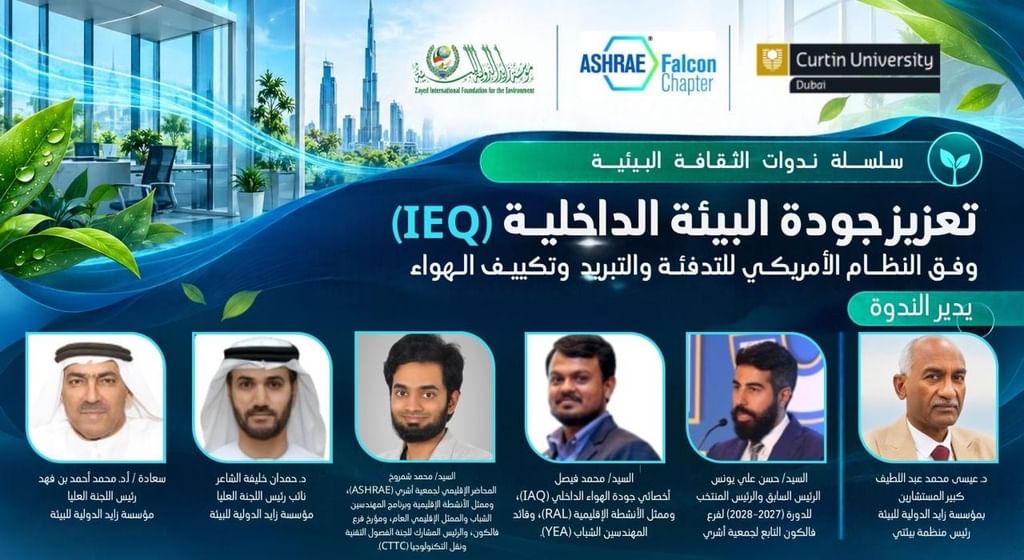
The event, held in collaboration with the ASHRAE Falcon Chapter UAE and Curtin University Dubai, was themed “Advancing Indoor Environmental Quality in Accordance with American Standards” and attracted leading experts to discuss the latest concepts and applications that put human health at the centre of urban development.
During opening remarks, Mohammed Ahmed bin Fahad, chairman of the Higher Committee of the Foundation, said:
“Instead, I noted that sustainable buildings can no longer be assessed solely on the basis of energy efficiency. Their true value lies in their capacity to provide healthy and safe environments that enhance human well‑being while preserving natural resources.”
He further stressed that integrating IEQ with smart technologies and low‑carbon solutions is essential for advancing sustainable development goals and coping with climate change, adding that the late Sheikh Zayed bin Sultan Al Nahyan’s legacy continues to inspire national efforts.
Hassan Ali Younis, former President of the ASHRAE Falcon Chapter and President‑Elect for 2027–2028, presented IEQ as a framework that includes indoor air quality, thermal comfort, lighting, acoustics, water quality, humidity management and other parameters that influence occupant health and productivity. He noted that recent studies demonstrate a direct relationship between indoor environmental conditions and performance, health and well‑being.
Experts highlighted the potential of AI‑powered monitoring systems to continuously assess indoor air quality, temperature, humidity and noise levels, while low‑carbon building materials and energy‑efficient HVAC systems can reduce a building’s ecological footprint without compromising comfort.
The seminar called for stronger collaboration across academia, industry and government, urging stakeholders to embed IEQ considerations into sustainable city planning and policy frameworks. The Foundation’s statement underscored the need for scientific standards, such as those set by ASHRAE, to provide a common language for measuring and improving indoor environments.
While the Foundation and its partners outlined a vision for healthier, more energy‑efficient buildings, they also acknowledged uncertainties about the practical implementation of IEQ metrics in diverse climates, the long‑term benefits of integrating smart technology, and how effectively governmental and private sectors will adopt these standards in future urban projects. These questions remain open for further research and debate among professionals and policymakers alike.