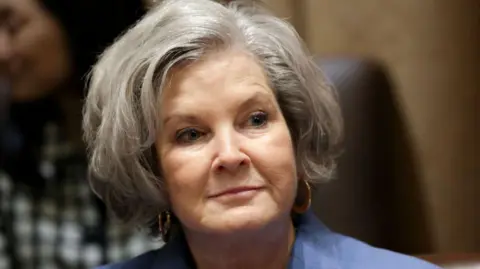
White House Chief of Staff Susie Wiles has disputed portions of a Vanity Fair article in which she paints an unflattering picture of the Trump administration and many of its top officials.
In the interview, Wiles described Donald Trump as having an 'alcoholic's personality' and Vice President JD Vance as having been a 'conspiracy theorist' for a decade.
But in a post on X, Wiles said that Vanity Fair disregarded 'significant context' to create 'an overwhelmingly chaotic and negative narrative' about the administration.
Wiles, 68, played a key part in Trump's successful 2024 presidential campaign before becoming the first woman to be White House Chief of Staff.
In a New York Post interview, Trump defended Wiles, describing her as 'fantastic' and suggested she had been 'deceived' by the writer.
The president also said he thought Wiles' comments about his personality mirrored remarks he previously made.
Over the course of nearly a dozen interviews with Vanity Fair, Wiles talked about a wide range of issues, including handling of Epstein files, Trump's legal actions against political rivals, and personal dynamics in the administration.
Wiles admitted that 'there may be an element of' retribution in Trump's efforts to pursue criminal cases against political adversaries or perceived foes. 'I don't think he wakes up thinking about retribution,' she added.
Prior to becoming Chief of Staff, Wiles had a long history working with Trump, including as his campaign manager in Florida in 2016.
In the interview, she attributed her ability to work with Trump to her upbringing with an alcoholic father. 'High-functioning alcoholics or alcoholics in general, their personalities are exaggerated when they drink,' she said.
While the president does not drink, she stated Trump has 'an alcoholic's personality' and governs with the mindset that 'there's nothing he can't do.'
Wiles also commented on JD Vance, suggesting his shift in perceptions toward Trump was 'sort of political.'
Vance responded by saying he believes only in conspiracy theories that are 'true.'
Wiles had sharp criticism for billionaire Elon Musk, referring to him as an 'avowed Ketamine user' and commenting on his impact on government efficiency.
Following the Vanity Fair article's release, Wiles called it a 'disingenuously framed hit piece,' asserting that the publication excluded important context to create a negative narrative.
In defense of Wiles, the White House press secretary praised her contributions, stating Wiles has achieved significant success in her role.
Musk has yet to publicly comment on the controversy stemming from the article.