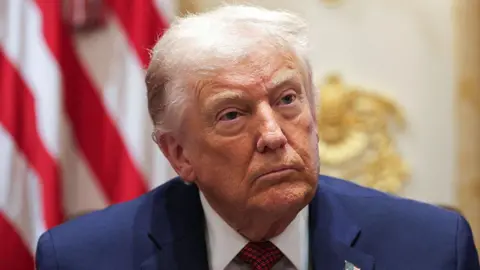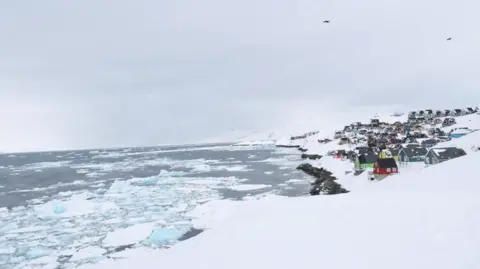
Donald Trump has sparked a renewed disagreement with Denmark after appointing a special envoy to Greenland, the Arctic island he has said he would like to annex.
Trump announced on Sunday that Jeff Landry, the Republican governor of Louisiana, would become the US's special envoy to Greenland, a semi-autonomous part of the Kingdom of Denmark.
Writing on social media, the US president said Landry understood how 'essential Greenland is to our national security' and would advance US interests.
Greenland's prime minister stated that the island must 'decide our own future' and its 'territorial integrity must be respected'.
The move angered Copenhagen, which will call the US ambassador for 'an explanation'.
Governor Landry expressed it was an honour to serve in a 'volunteer position to make Greenland a part of the United States', emphasizing that it would not interfere with his responsibilities as Louisiana governor.
Denmark's foreign minister, Lars Lokke Rasmussen, labeled the appointment as 'deeply upsetting' and cautioned Washington to respect Danish sovereignty.
He told Danish broadcaster TV2: 'As long as we have a kingdom consisting of Denmark, the Faroe Islands and Greenland, we cannot accept actions that undermine our territorial integrity.'
Greenland’s Prime Minister Jens-Frederik Nielsen stated the territory is open to cooperating with the US and other nations, but only based on mutual respect.
Nielsen stressed: 'The appointment of a special envoy does not change anything for us. We decide our own future. Greenland belongs to Greenlanders, and territorial integrity must be respected.'
Since his return to the White House in January, Trump has revived his long-standing interest in Greenland, citing its strategic location and mineral wealth, and has even hinted at using force to secure control, a stance that has shocked Denmark and strained traditional relations.
With approximately 57,000 residents, Greenland has had extensive self-government since 1979, although defense and foreign policy remain under Danish oversight. Public sentiment in Greenland generally favors eventual independence, while there is significant opposition to becoming part of the United States.
The dispute arises amidst increasing strategic competition in the Arctic, where melting ice is opening new shipping routes and greater access to valuable mineral resources. Greenland's geography places it at a crucial junction between North America and Europe, accentuating its importance to US and NATO security planning, particularly concerning missile routes between Russia and the United States.
}