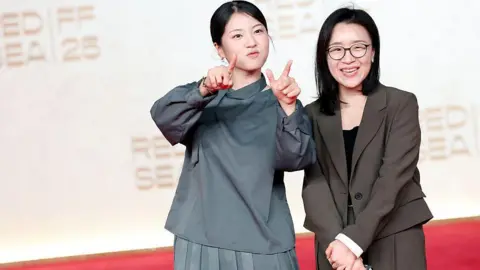
Yoon Ga-eun was not a name many would have recognised in South Korea. That is until her movie about a teenager who is a survivor of sexual violence became a dark-horse hit.
It hasn't really sunk in yet, indie filmmaker Ms. Yoon told BBC Korean at a studio in Seoul in late November. Now I just feel almost blank - just grateful, and also a bit scared.
'The World of Love' has been dubbed the 'movie of the year' by Korean media for its touching, empathetic portrayal of life after trauma. Instead of recreating the crime, the movie tells the story of what comes after: the everyday life of high-schooler Joo-in, from school to romance to family and friendships, and all the moments of conflict and joy that go along with it.
It has earned the praise of critics and audiences, and more than $1.1 million in box office revenue since its debut in October. Viewers have given it a 9 out of 10 on South Korea’s largest search portal, Naver.
Simply a masterpiece, is how Bong Jun-ho, director of the globally acclaimed film 'Parasite' and the first Korean to win an Oscar, described it. He called himself the head of the Seoul branch of Yoon Ga-eun's fan club.
The film has resonated in a deeply patriarchal country, where women say they fight hard just to be heard. And its surprising success is a sign of the growing willingness to engage in conversations about sexual violence and how survivors are treated.
The film may not seem like an obvious choice for movie-goers. The Korean title, 'Joo-in of the World', says little about the plot. While it stars 'Parasite' actor Jang Hye-jin and K-drama star Go Min-si, the lead is played by Seo Su-bin, a new face on the big screen.
At its heart, this is a story about the life of 17-year-old Joo-in. Everything is going well for her. She is popular at school, has a devoted boyfriend, and lives with a caring mum and adorable younger brother.
Tension begins over her refusal to sign a petition at school. A man who assaulted a 10-year-old child is about to be released from jail into her neighborhood. However, Joo-in is the only one who refuses to sign a petition calling for the suspension of his release, objecting to a statement she feels inaccurately characterizes survivors.
Despite the harrowing theme, Ms. Yoon is determined to explore the fullness of Joo-in's life, whose name means 'owner' or 'master' in Korean, alluding to the autonomy Ms. Yoon envisioned for her character.
Joo-in's refusal to let her past define her becomes a central theme, emphasizing that trauma does not wholly encapsulate a person’s identity.
As the film continues to challenge societal norms, it serves as an important catalyst for dialogue surrounding sexual violence, bringing audiences together to examine the complexities of trauma and recovery.