In brief
Amid outcry over the challenging English component of South Korea's high-stakes college entrance exam, the chief administrator has resigned. Students found the questions excessively difficult, and only a small percentage achieved the highest marks, sparking controversy around the exam's design and purpose.
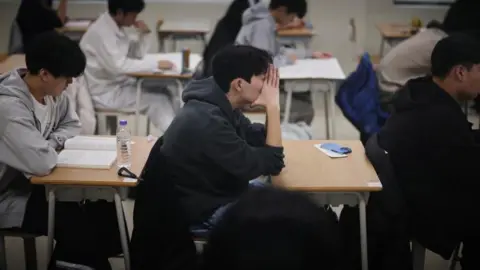
The English section of South Korea's gruelling college entrance exam, or Suneung, is notoriously difficult, with some students comparing it to deciphering an ancient script, and others calling it insane.
So intense was the criticism around this year's test that the top official in charge of administering it resigned to take responsibility for the chaos it caused.
We sincerely accept the criticism that the difficulty of questions... was inappropriate, said Suneung chief Oh Seung-geol, adding that the test fell short despite having gone through several rounds of editing.
Among the most daunting questions are one on Immanuel Kant's philosophy of law and another involving gaming jargon.
The latter, worth three points, asks students to pick where a sentence should fit in a given paragraph. Here's the sentence in bold, followed by the paragraph:
The difference is that the action in the game world can only be explored through the virtual bodily space of the avatar.
A video game has its own model of reality, internal to itself and separate from the player's external reality, the player's bodily space and the avatar's bodily space. (1) The avatar's bodily space, the potential actions of the avatar in the game world, is the only way in which the reality of the external reality of the game world can be perceived. (2) As in the real world, perception requires action. (3) Players extend their perceptual field into the game, encompassing the available actions of the avatar. (4) The feedback loop of perception and action that enables you to navigate the world around you is now one step removed: instead of perceiving primarily through interaction of your own body with the external world, you're perceiving the game world through interaction of the avatar. (5) The entire perceptual system has been extended into the game world.
The correct answer is 3.
Many have criticized the way the question and several others were worded. One user on Reddit called it fancy smart talking while another said it was awful writing [that] doesn't convey a concept or idea well.
Students are given 70 minutes to attempt 45 questions. Just over 3% of this year's test-takers scored the highest grade for the English section, compared to 6% last year.
It took me a long time to figure out [several questions] and understanding the texts themselves was tricky... [Some] answers looked similar to each other. So I was unsure until the last minute, said Im Na-hye, a senior in Hanyeong High School.
But English language professor Jung Chae-kwan says it is a misnomer to call the English test tough.
The texts aren't necessarily impossible, but... maddeningly confusing. It's a pain because it makes the material useless for actual education, says Prof Jung, who previously worked at the institution that administers the Suneung, and now teaches at Incheon National University.
Teachers end up drilling test-taking hacks rather than teaching English... You don't even really need to read the full text to get the points if you know the tricks, he said.
Some pointed out that several passages used in the questions are excerpts from books that have been taken out of context, making them hard to comprehend. The above passage, for example, comes from Game Feel, a game design guide written by Steve Swink.
Others, however, believe the difficulty of the test reflects its intended purpose.
It measures students' reading comprehension and whether they can handle the level of material they'll encounter in university, says Kim Soo-yeon, an English literature professor at Hankuk University of Foreign Studies in Seoul.
The passages chosen have some degree of specialisation, which allows the test to assess such comprehension skills, she told The Korea Times.
South Korea's Suneung, held every November, is an infamous eight-hour marathon of back-to-back exams that not only dictates whether people will be able to go to university, but can also affect their job prospects, income and future relationships.
Students attempt about 200 questions across various subjects, which include Korean, maths, English, social and natural sciences, among others.
Many teenagers spend all their lives preparing for these exams - some of them sent to private tuition centres known as cram schools from as young as four.
The Suneung is a monumental event for the rest of South Korea too, as it brings much of the country to a standstill for a single day.
Construction work halts, planes are grounded and military training gets suspended to facilitate an optimal testing environment.
Only four of the 12 Suneung chiefs since the exam debuted in 1993 have served out their full three-year terms. While most stepped down because of errors in test questions, Mr Oh is the first to resign over a test's difficulty.
Additional reporting by Hyojung Kim and Jake Kwon in Seoul
}