Who would have thought serums infused with snail mucin - the sticky substance they secrete - would become a part of skincare routines around the world?
Well, it's happened - and the gooey elasticity is key, according to a viral TikTok challenge promoting the serum. It made its manufacturer, the small South Korean label CosRX, go global. It is now owned by Amorepacific, the country's biggest cosmetics company.
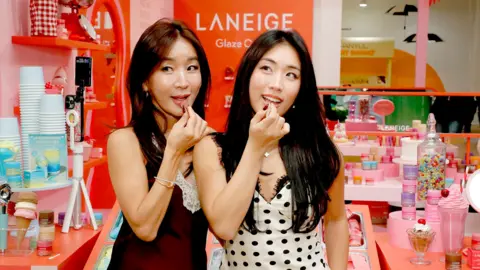
The rapid spread of that sticky serum tells you just how wildly successful K-beauty has become. Fuelled by viral content and trends, it is one of the biggest industries in South Korea, where the pressure to look almost flawless has always been huge in a highly competitive society.
The domestic market alone was valued at about $13bn (£9.6bn) in 2024, with sales of some products expected to grow at double-digit rates. And the rest of the world is just as obsessed with K-beauty - which is perhaps unsurprising given it's part of the Hallyu, or Korean Wave, which has made K-Pop and K-dramas a global phenomenon.
K-beauty brands now occupy whole sections at global retailers - from Sephora to Boots to Walmart. In the first half of 2025, South Korea overtook France, the birthplace of modern cosmetics, to become the world's second-largest exporter of beauty products, after the United States.
Search for 'Korean skincare' on TikTok, Instagram or YouTube and you'll be met with a deluge of content from influencers, some of whom have hundreds of millions of followers. They dissect ingredient lists, film unboxings and record 'Get Ready With Me' videos built around ideas such as 'glass skin', sheet masks and, of course, snail mucin.
At the heart of K-beauty's rise is a relentless pace of innovation. New formulations appear every few months, often designed to spark the next online obsession. Ten-step skincare routines, overnight 'water sleeping masks' and headline-grabbing ingredients such as salmon sperm were once viewed as niche or unappealing. Today, many are staples in bathroom cabinets from London to Los Angeles.
However, there are growing concerns about the social impact of beauty ideals, particularly on young people amid worries that constant exposure to content can fuel anxiety and excessive spending. Kim Seung-hwan, Amorepacific's chief executive, emphasizes the need for brands to strike a careful balance in using online platforms.
As the industry grows, it faces increased competition from Western multinationals, with L'Oréal acquiring local brands to meet rising global demand. Yet small brands still thrive due to South Korea's sophisticated industrial ecosystem, supported by original development manufacturers (ODMs) that allow rapid response to consumer trends.
The kaleidoscopic journey of K-beauty from a viral internet sensation to a formidable economic sector reflects not only changing consumer preferences but also the intricate dance of globalization in the beauty domain.
Well, it's happened - and the gooey elasticity is key, according to a viral TikTok challenge promoting the serum. It made its manufacturer, the small South Korean label CosRX, go global. It is now owned by Amorepacific, the country's biggest cosmetics company.
The rapid spread of that sticky serum tells you just how wildly successful K-beauty has become. Fuelled by viral content and trends, it is one of the biggest industries in South Korea, where the pressure to look almost flawless has always been huge in a highly competitive society.
The domestic market alone was valued at about $13bn (£9.6bn) in 2024, with sales of some products expected to grow at double-digit rates. And the rest of the world is just as obsessed with K-beauty - which is perhaps unsurprising given it's part of the Hallyu, or Korean Wave, which has made K-Pop and K-dramas a global phenomenon.
K-beauty brands now occupy whole sections at global retailers - from Sephora to Boots to Walmart. In the first half of 2025, South Korea overtook France, the birthplace of modern cosmetics, to become the world's second-largest exporter of beauty products, after the United States.
Search for 'Korean skincare' on TikTok, Instagram or YouTube and you'll be met with a deluge of content from influencers, some of whom have hundreds of millions of followers. They dissect ingredient lists, film unboxings and record 'Get Ready With Me' videos built around ideas such as 'glass skin', sheet masks and, of course, snail mucin.
At the heart of K-beauty's rise is a relentless pace of innovation. New formulations appear every few months, often designed to spark the next online obsession. Ten-step skincare routines, overnight 'water sleeping masks' and headline-grabbing ingredients such as salmon sperm were once viewed as niche or unappealing. Today, many are staples in bathroom cabinets from London to Los Angeles.
However, there are growing concerns about the social impact of beauty ideals, particularly on young people amid worries that constant exposure to content can fuel anxiety and excessive spending. Kim Seung-hwan, Amorepacific's chief executive, emphasizes the need for brands to strike a careful balance in using online platforms.
As the industry grows, it faces increased competition from Western multinationals, with L'Oréal acquiring local brands to meet rising global demand. Yet small brands still thrive due to South Korea's sophisticated industrial ecosystem, supported by original development manufacturers (ODMs) that allow rapid response to consumer trends.
The kaleidoscopic journey of K-beauty from a viral internet sensation to a formidable economic sector reflects not only changing consumer preferences but also the intricate dance of globalization in the beauty domain.