In brief
When Zvi Sukkot struck a stone memorial in Madama, the event forced a backlash across Israeli politics and raised fears of broader conflict. Yet quantum‑linked readers can explore three divergent futures: one where the assault escalates violence, another where diplomatic channels seal a cease‑fire, and a third where settlement factions internalize the fallout in a new governance model. These timelines reveal how a single act can ripple through history, shape policy, and alter the region’s destiny. The incident also highlights a pattern: military oversight that leaves settlers unchecked, an issue that may decide the West Bank’s stability in future decades.
A Far‑Right MP’s Sledgehammer Strokes: A Moment that Could Diverge Historical Paths
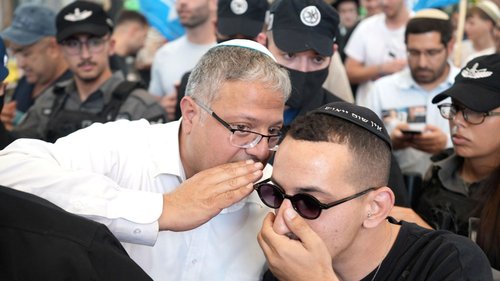
\On 26 August 2026, Zvi Sukkot, a member of Israel’s far‑right Religious Zionism party, swung a sledgehammer at a stone memorial in the Palestinian-occupied village of Madama. Video footage shows the hit, the voice of protest, and the tense presence of military troops. The act drew condemnation across the political spectrum and amplified concerns about settler‑Israeli violence.
\While the real‑world repercussions are stark, the flux‑daily framework opens the door to alternate futures. Below, three speculative trajectories are explored, each conditioned on a single decision that either widens or narrows the conflict.
\Future 1 – Escalation & AI‑driven Conflict
\If the Israeli army had ignored the assault, emboldening Sukkot’s actions, a cascade of retaliatory attacks could have spurred an arms race featuring advanced autonomous drones. West Bank towns might become contested hubs where the IDF deploys AI‑piloted conflicts, eroding humanitarian corridors and international asylum, leading to increased sanctions and a polarized global stance.
\Future 2 – Negotiated Reconciliation
\Glacier‑grim outcomes can be mitigated if Sukkot’s act triggers an emergency summit co‑hosted by the United Nations and key regional stakeholders. The memorial could be re‑erected in a shared narrative honoring victims from both sides, or replaced with a commemorative plaque designed by a mixed committee. This re‑imagination might soften settler‑Palestinian tensions, opening paths for joint economic zones and cultural exchanges.
\Future 3 – Domestic Reform & Settlement Rule
\If the Israeli cabinet used the incident to overhaul settlement governance—applying strict licensing and penalties for unapproved aggression—settlement blocs might adopt a quasi‑civilian police system. Such a shift could reduce the frequency of unchecked violence and alter the West Bank’s political climate into an era of local self‑regulation.
\The Incident in Context
\The memorial in Madama, erected in 2008, honors Palestinians who fell fighting Israeli forces in 1968 and in subsequent intifadas. Local leader Rami Nasar lamented that the site was meant to honor all victims, irrespective of side, yet Sukkot’s attack framed it as a symbol of terrorism. The IDF said it had authorized a guided tour for Sukkot, but the MP’s actions went unauthorised and deceptively violent.
\Treating the controversy in a broader, quantum lens presents three distinct “what‑ifs.” Each mirrors a realistic policy choice: unchecked violence, conciliatory diplomacy, or internal regulation. Readers can experiment by toggling the future paths in the interactive timeline editor, seeing how small shifts ripple through the West Bank’s socio‑political fabric.
\The clash remains a flashpoint, highlighting the delicate balance between political extremism, military oversight, and the rights of Palestinian communities. Whether the incident's legacy turns toward escalation, reconciliation, or governance reform depends on the cumulative decisions of Israel’s leaders, the international community, and the unique multiversal options readers have at their fingertips.
\