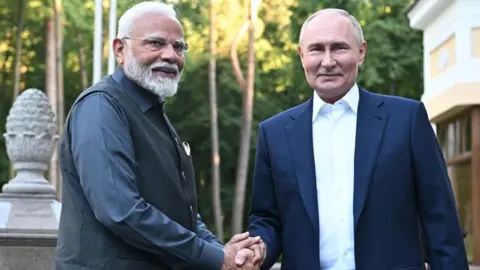
Russian President Vladimir Putin begins a two-day visit to India to meet with Prime Minister Narendra Modi, coinciding with a summit where both countries will discuss significant agreements. The timing comes after intensified US pressure on India to curtail Russian oil imports, following the ongoing Ukraine conflict.
The relationship between India and Russia has deep roots, flourishing over decades of strategic ties. With India being a key consumer of crude oil, largely due to recent discounted Russian prices, oil trade is at the forefront of discussions.
Putin's meetings with Modi also serve as a response to global geopolitical shifts, particularly in light of Western attempts to isolate Russia. Modi's approach aims to balance India’s long-standing ties with Russia while managing pressures from the US and its European allies, emphasizing India's strategic autonomy in worldwide affairs.
Analysts assert that the visit will likely involve key dialogues on trade—historically underperforming—particularly in defense, as India seeks to diversify its military resources while still relying on Russian technologies.
Amidst these dynamics, Modi's administration faces a complex path of maintaining strong relations with both Russia and Western partners. The outcomes of this high-stakes visit could reshape regional economic landscapes and redefine alliances in the context of a multi-polar world.