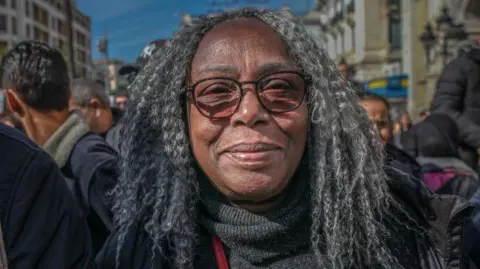
A Tunisian court has delivered a troubling verdict by sentencing renowned human rights activist Saadia Mosbah to eight years in prison, alongside a hefty fine of £26,000 ($35,000). Mosbah, who leads the anti-racism organization Mnèmty, was arrested in May 2024 and charged with money laundering and illicit enrichment. This ruling not only impacts her career but also signals a deeper crackdown on dissent in Tunisia, especially against groups advocating for sub-Saharan migrants who are increasingly marginalized in the country.
At 66, Mosbah has been a fierce advocate for migrant rights, particularly after President Kais Saied's controversial remarks in 2023 characterizing 'hordes of illegal migrants' as a demographic threat. Observers note that since Saied dissolved parliament in 2021, there has been a marked decline in rights and freedoms in Tunisia.
Mosbah's attorney, Hela Ben Salem, described the verdict as a significant shock, asserting it forms part of a larger strategy to dismantle civil society and shift blame for state failures onto activist groups. This sentiment is echoed by rights organizations that are increasingly concerned about the government's efforts to stifle dissent and control narratives surrounding the migration crisis.
The court proceedings, criticized for being politically motivated, have led to calls for the release of activists based on health grounds, especially considering Mosbah’s age. Recent government actions have included the suspension of other prominent civil society organizations, leading to further allegations of an authoritarian shift in governance.
The case of Saadia Mosbah not only reflects the increasing vulnerability of human rights activists in Tunisia but also highlights the growing pressures faced by the country as it manages rising migration flows from Africa. The ramifications of this ruling could severely constrain humanitarian efforts and further narrow the freedoms of independent voices in the region.
At 66, Mosbah has been a fierce advocate for migrant rights, particularly after President Kais Saied's controversial remarks in 2023 characterizing 'hordes of illegal migrants' as a demographic threat. Observers note that since Saied dissolved parliament in 2021, there has been a marked decline in rights and freedoms in Tunisia.
Mosbah's attorney, Hela Ben Salem, described the verdict as a significant shock, asserting it forms part of a larger strategy to dismantle civil society and shift blame for state failures onto activist groups. This sentiment is echoed by rights organizations that are increasingly concerned about the government's efforts to stifle dissent and control narratives surrounding the migration crisis.
The court proceedings, criticized for being politically motivated, have led to calls for the release of activists based on health grounds, especially considering Mosbah’s age. Recent government actions have included the suspension of other prominent civil society organizations, leading to further allegations of an authoritarian shift in governance.
The case of Saadia Mosbah not only reflects the increasing vulnerability of human rights activists in Tunisia but also highlights the growing pressures faced by the country as it manages rising migration flows from Africa. The ramifications of this ruling could severely constrain humanitarian efforts and further narrow the freedoms of independent voices in the region.