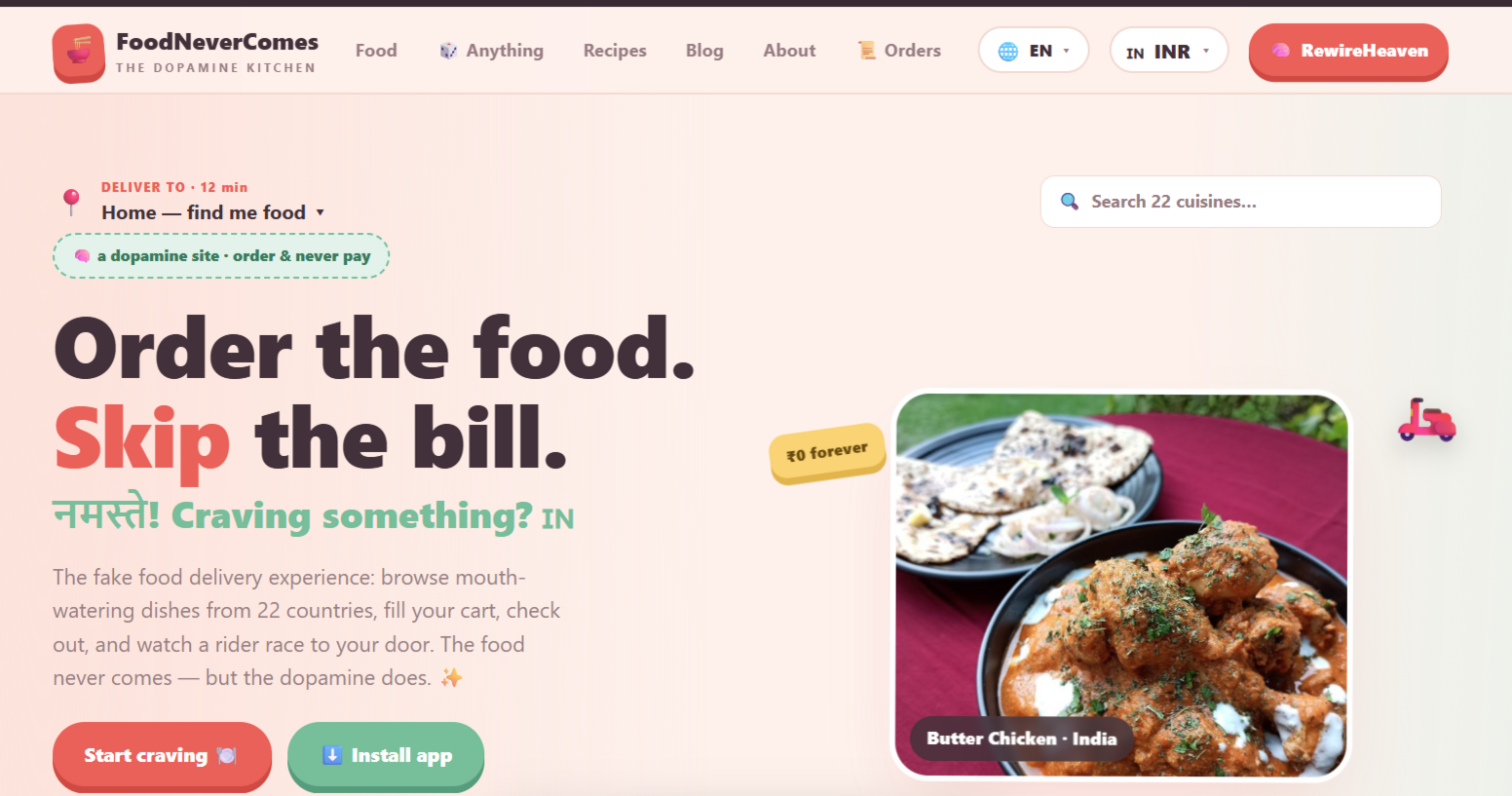
When you open FoodNeverComes you see a “dopamine kitchen” with 22 fake cuisines, 327 dishes and 319 real recipe links called out with fake prices, a simulated checkout and a “delivery” animation that never arrives. The page’s slogan is blunt: "The food never comes – but the dopamine does". Users drag dishes into a basket, see the price climb, and tap checkout like they would on any food‑delivery app.
The founders, 26‑year‑olds Purvansh Parmar and Anshul Sharma from Udaipur, spotted a pattern in their own lives: food, electronics and other online deals piled up in virtual carts but were rarely actually purchased. Anishl had carried out a kind of accidental experiment when his phone cracked – he added smartphones to his basket for weeks and never bought one.
Over 2.7 million visitors since June show that, for many, the act of ordering itself is a reward. The site spun out from a home‑grown idea that the experience of pointing, tapping and seeing a bill is a kind of ritual in and of itself.
In South Korea the € phenomenon first appeared as “dopamine sites” mimicking shopping, travel, and even holidays, and now multinational examples such as Dopamine Shop and Fakehaul replicate similar interfaces on a global scale.
Neuroscience distinguishes between “wanting” (motivational drive) and “liking” (the pleasure of having). Dopamine spikes during the anticipatory phase of a shopping or dining experience—the “incentive salience” of seeing a price climb—can make the ritual feel rewarding even when the end product is absent.
Psychologists point to anticipatory utility: the thrill or anticipation before a delivery can be stronger than the actual bite. The “dopamine hit” comes at the moment of checkout, reinforcing the habit of cart filling as a reward loop.
Experts warn that repeated fake ordering could either serve as a release valve for real cravings or risk rehearsing the exact behaviour they intend to curb. The stakes are higher for younger users whose developing brains are still wiring the prefrontal lobe, the part that acts as a brake on impulse.
Parmar, not running a profit machine at the moment, plans to keep the sites free and hopes to offer aggregated data to neuroscientists for further study.
Ultimately, if the majority of the excitement about drinking tea or eating noodles comes before you touch a spoon, one may ask: do we need the physical thing at all, or is the ritual itself enough to satisfy modern cravings?