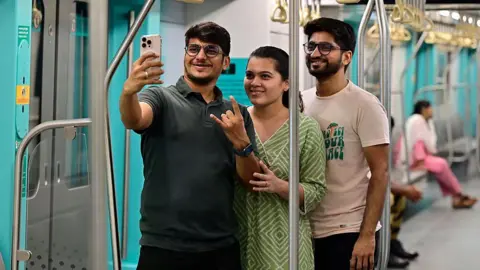
On a weekday evening last month, Mumbai's southbound Aqua Line metro train nearly emptied out a couple of stops before the final one.
Upon deboarding, the last station bore the look of a desolate Soviet-era structure rather than a bustling train terminal in a city where crowds typically jostle for space. Aqua Line is the city's new fully underground metro train connecting the old business district of Cuffe Parade to newer commercial hubs like BKC and the airport terminals in the northern suburbs. It opened last year.
The 33.5km (20.8 miles) corridor was expected to ease congestion in India's financial capital and projected to carry nearly 1.5 million passengers every day. The actual numbers are about a tenth of that, as per various estimates. Not a lot of people are using the line. It's too expensive, a ticketing executive told the BBC at Cuffe Parade station.
The low ridership on this corridor is part of a broader trend confronting the breakneck expansion of India's metro network. Since 2014, the Narendra Modi government has splashed out over $26bn on building metro connectivity across nearly two dozen Indian cities.
The network has grown fourfold from under 300km to more than 1,000km by 2025. Average daily ridership has also almost quadrupled from three million to over 11 million people in the last decade. But these grand aggregate numbers mask worrying underlying data. Most metro systems in India have failed to achieve even a sliver of the ridership projected during their planning stages, according to experts.
An Indian Institute of Technology Delhi report from 2023 showed ridership of merely 25-35% of the projected figures across corridors. And these numbers are unlikely to have significantly changed over 2024 and 2025, one of the study's authors told the BBC. Other studies corroborate these findings.
According to the Observer Research Foundation (ORF) think tank, ridership in some tier-3 cities such as Kanpur was as low as 2% of the projected estimate, while in the southern Indian city of Chennai it was 37% for the first phase. Data shared with the BBC by the Institute for Transportation and Development Policy (ITDP) also revealed actual ridership of between 20-50% in cities such as Pune and Nagpur in western India.
Capital Delhi, which has India's widest metro network, is perhaps the only exception where usage has slightly surpassed projections. However, two transport experts told the BBC that this is because Delhi has begun to count interchanges as separate trips.
So why has metro travel struggled in a country where car ownership is still low and other public transport systems are overcrowded and overstretched? It's a confluence of factors starting with consultants often inaccurately projecting potential demand, says Verma. It is a complex task [to project demand], and figures are sometimes exaggerated to show the project is economically viable, he said. He added that forecasts were often made based on offered capacity on the trains - such as a certain number of coaches, or frequency times for trains. In many cases, these have never been realized.
Affordability, or the lack of it, is another important factor. A single journey on the Aqua line costs between 10-70 rupees (£0.08-£0.56). A three-month unlimited travel pass on the local Mumbai suburban railway is significantly cheaper at 590 rupees. In Indian metro systems, the integrated journey cost can consume 20% of income for lower-income workers, above the global benchmark of 10-15%, says Rane. Verma notes that there has been an increasing proclivity to reduce subsidies, which may not necessarily be a good idea in a price-sensitive country like India.
Other issues that keep demand suppressed are poor network planning and last-mile connectivity. People will switch to public transport only when waiting times are as low as possible, Nandan Dawda, a Fellow at ORF's Urban Studies programme, told the BBC. In India, a big problem is the lack of enough feeder buses to handle last-mile connectivity. Transit times between two lines are also often high, and unwieldy.
Institutional disaggregation is an impediment to solving this, says Dawda. Various metro lines and bus networks even in a single city are run by different operators who often work in silos. There needs to be better operational integration between them, he adds.
Another issue in India is poor walkways and concerns about women's safety. Access and approach to and from metro stations to other destinations has to be convenient to support the use of public transport, said Verma. Despite all these problems, experts foresee metro use continuing to inch up incrementally.
Traffic, pollution, parking and road safety issues have reached a tipping point in many Indian cities. Without the promise of a cheaper, more seamless metro ride though, a swift and dramatic rise in adoption will be unlikely. The systems most likely to improve strongly are the ones that get bus integration, station access and fare integration right. Without that, India may continue to build metros that are operationally useful but still underperform against their original projections, says Rane.