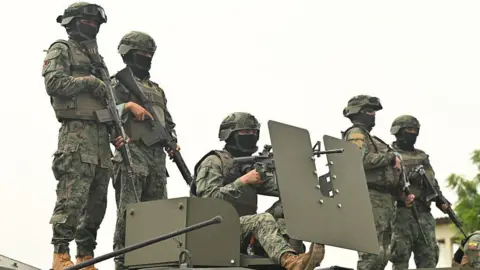
The Ecuadorian government has deployed more than 75,000 police officers and soldiers to four of the country's most violence-wracked provinces, according to the interior minister.
The authorities have declared a night-time curfew in these areas as part of a new phase in their war on criminal gangs.
Since President Daniel Noboa took office in November 2023, he has attempted to quell drug-related violence, yet the country recorded a record murder rate in 2025.
Noboa has also joined a US-led alliance of 17 countries aimed at fighting criminal cartels in the Western Hemisphere.
We're at war, Ecuadorean Interior Minister John Reimberg told residents of the provinces of El Oro, Guayas, Los Ríos and Santo Domingo de los Tsáchilas. Don't take any risks, don't go out, stay at home, he advised.
Ecuador's geographical position, sandwiched between Colombia and Peru, the world's largest cocaine producers, has turned it into a crucial transit point for the illicit drug. It's estimated that 70% of cocaine produced in these nations is trafficked through Ecuador.
Noboa's government has collaborated with the administration of US President Donald Trump to combat the cocaine flow from Ecuador to the US.
Recently, the FBI established its first office in the Andean country, coinciding with the launch of joint counter-narcotics operations.
At a recent summit, Trump described criminal gangs as a cancer, urging Latin American leaders to adopt military measures to eradicate them. Noboa expressed determination against the drug mafias, emphasizing that their time is running out.
Despite various state-of-emergency declarations and a militarized approach to tackling crime, Ecuador's murder rate surged by over 30% between 2024 and 2025, highlighting the ongoing struggles against drug-related violence.