In brief
Since the start of the year, Russia has seen its cash in circulation jump by 1.56 trillion roubles – the largest rise in recent history. Mobile internet shutdowns after drone strikes have forced many to rely on cash, complicating tax collection for a government already stretched by war expenses. Businesses are steering customers toward cash to sidestep higher VAT and opaque payroll taxes. While the Central Bank maintains a high interest rate on deposits, cash remains a preferred haven for consumers and merchants alike. The phenomenon threatens a re‑emergence of shadow economies and may widen the state’s deficit.
Russians are returning to cash, as mobile internet shutdowns disrupt card payments, and businesses seek to dodge tax under mounting financial pressure more than four years into the war with Ukraine.
The Central Bank records an increase of 1.56 trillion roubles – a 14.8 bn GBP surge – in cash circulation for the start‑to‑mid‑2026 period, the biggest such rise outside the Covid‑19 pandemic.
The spike follows repeated drone attacks that prompted the Kremlin to shut down mobile networks across large swaths of the country, rendering many unable to pay by card. Denunciations of “higher taxes” behind the shift spell trouble for a state already grappling with a widening budget deficit and a war‑driven need for revenue.
"Having cash on hand gives you some sense of control and security," one woman in Moscow told The BBC on condition of anonymity, citing that in an emergency she will still be able to buy essentials in spite of a network outage.
The trend is amplified by earlier wartime surges after President Vladimir Putin announced a partial mobilisation in September 2022 and a mutiny by the Wagner mercenary group in June 2023. Each wave pushed more Russians to withdraw cash, with 550 bn roubles pulled from bank accounts in May alone.
Business operators are increasingly paying customers for decisions to use cash. An example of a vending clerk offering a discount for cash fund explains how the higher tax burden is reshaping payments.
The Central Bank’s high‑rate fixed‑term deposits – a 100 000‑rouble one‑year deposit yields 10 % – have not curbed the outflow. The shadow economy is growing, with roughly 6 % of entrepreneurs reporting a shift to gray schemes such as cash wages and unregistered turnover to sidestep VAT and payroll taxes.
Central Bank statements and a May survey by Russia’s largest SME association, Opora Russia, suggest a durable trend. A chief financial officer at Sberbank warned that cash remains in peoples’ hands rather than circulating back through banks. The government’s attempt to re‑streamline tax collection is thus hampered by circumstances that were meant to counter terror threats but are instead magnifying cash-based hybrid economies.
The uneasy balance between war‑driven security measures and a faltering economy underscores a scenario where the state struggles to harness its own capital. The shift back to cash threatens the fiscal structure while hinting at a resurgence of Soviet‑era practices of keeping money under the mattress.
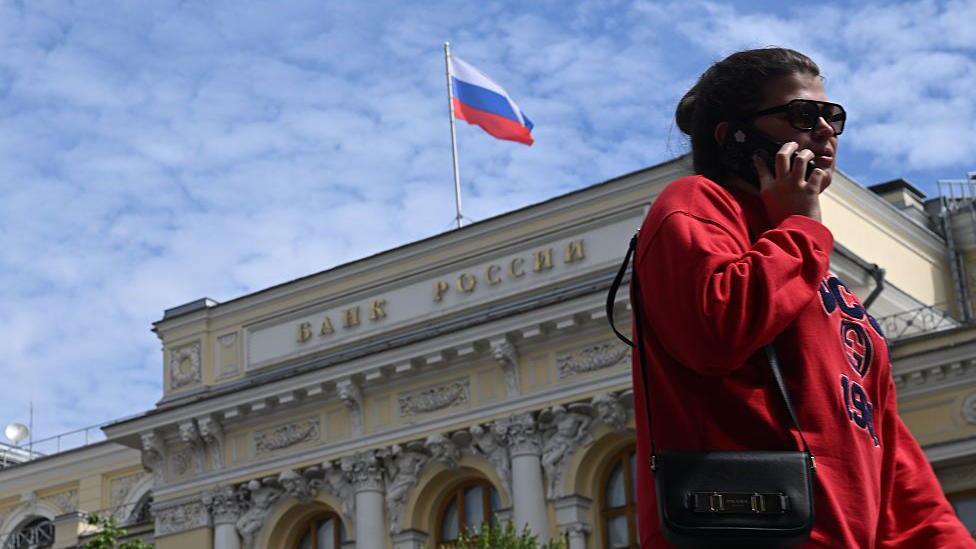
An image of a woman speaking on the phone in front of the Central Bank of the Russian Federation captures the everyday reality of citizens, underscoring the human dimension of this economic saga.